Key Takeaways
- A governance strategy starts with a business problem, not with a framework or a tool.
- Six parts cover it: goals, scope, ownership, rules, tooling and measures.
- Begin with one or two domains, show a result in 90 days and then expand.
- Track ownership coverage, access time, disputed reports and quality scores every month.
Most data governance strategies fail for a simple reason: they describe an ideal state and skip the first step. A long framework, a steering committee and a tool purchase come first, and then nothing changes in how people work. In my data governance consulting work, the strategies that last are short, name real people and start with one painful problem.
This guide gives you a six-part strategy you can write in a week. It covers the priorities to set, the operating model to use and the measures that tell you whether it works. You will also find a table you can copy into your own plan.
The Six Parts of a Working Governance Strategy
Each part answers one question. If you can answer all six in writing, you have a strategy. If you cannot, you know where to focus next.
| Part | Question it answers | What to write down |
|---|---|---|
| 1. Goals | Why are we governing data? | Two or three business outcomes with a baseline |
| 2. Scope | Which data comes first? | One or two domains, with reasons |
| 3. Ownership | Who decides? | Sponsor, governance lead, owners, stewards |
| 4. Rules | What must people do? | Definitions, quality, access and retention standards |
| 5. Tooling | What supports the rules? | Catalog, lineage and quality tools, only where needed |
| 6. Measures | How do we know it works? | Four to six metrics with monthly reviews |
1. Set Goals That a Finance Lead Would Recognize
Vague goals such as "improve data quality" give nobody a reason to act. Tie each goal to a cost or risk your leaders already feel: closing the books faster, answering audit questions in days, shortening the wait for data access or making AI projects safer to launch.
Write down the baseline before you start. If month-end reporting takes six working days today, say so, and set a target. Without a baseline, you cannot prove the strategy worked, and sponsors lose interest within two quarters.
2. Choose the First Domain With a Simple Score
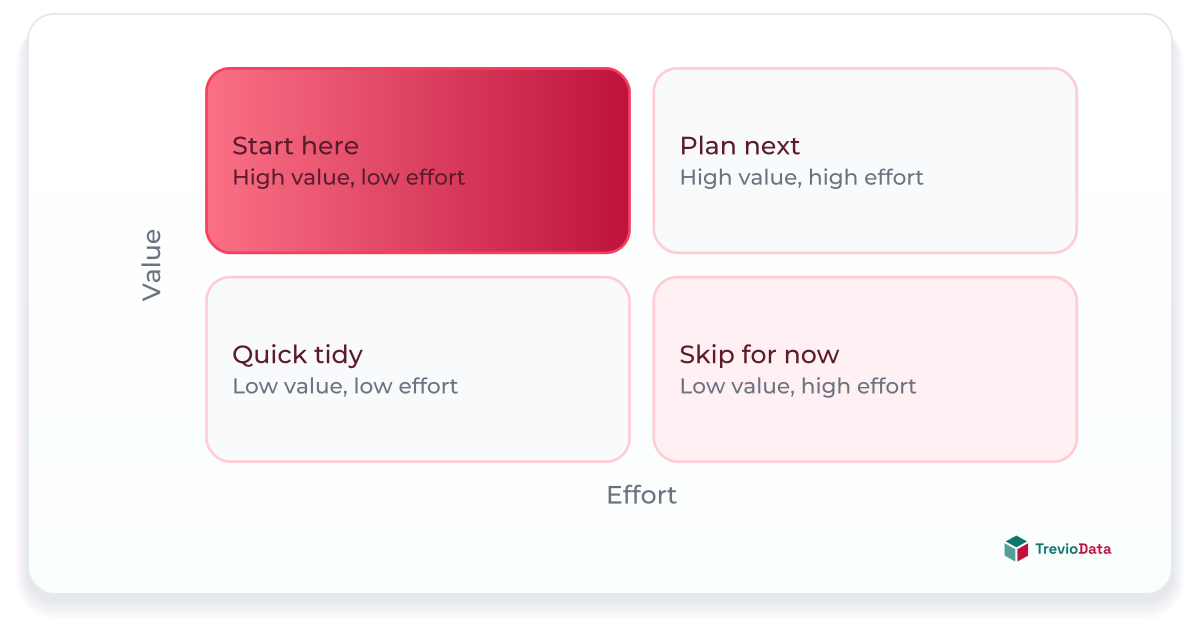
Governing everything at once is the most common way to fail. Pick one or two data domains, such as customer, product, finance or patient data, and score each from one to five on business value, cost of errors, sensitivity and effort. Value and error cost push a domain up the list, and effort pushes it down.
A domain that scores high on value and low on effort makes a good first project, because you can show a result in weeks. Sensitive domains such as patient or payment data often rank high on risk, and they deserve early attention even when the effort is large. Your ranked list also shows leaders why the other domains wait, which avoids arguments later.
If you are unsure where to start, my list of data governance use cases ranks eleven scenarios by return, and many teams pick their first domain from the top of it.
3. Name Real People, Not a Committee
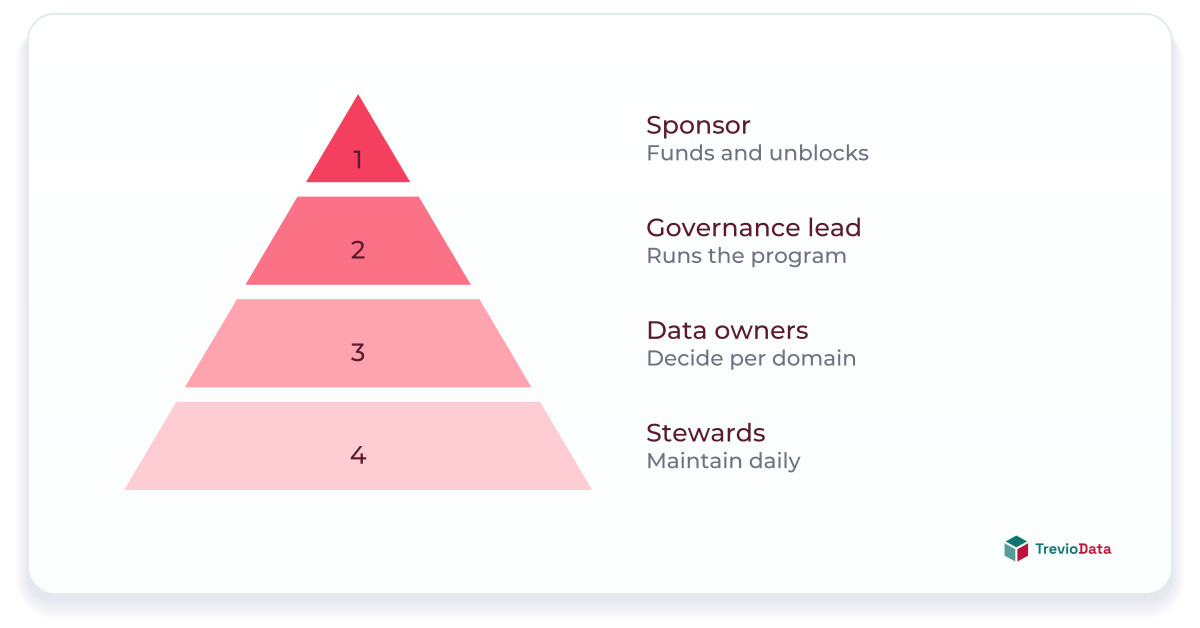
Governance runs on a small number of roles. A sponsor removes blockers, a governance lead runs the program, each domain has an owner who decides and each domain has a steward who handles daily questions. A council meets monthly to settle conflicts across domains.
Put names next to each role in the strategy. In my experience, roles filled with job titles such as "head of sales ops" survive reorganizations better than roles filled with individuals, so record both. Keep owners on the business side. When IT owns the definitions, business teams treat governance as somebody else's job.
A Lean Operating Model for the First Year
For the first year, I suggest a monthly 45-minute council, a shared issue queue with a target response time and a short written decision log. Decisions go into the log with the owner, the date and the reason. That log becomes your best training material, because new owners see how earlier disputes were settled.
4. Write Rules People Can Apply Without a Manual
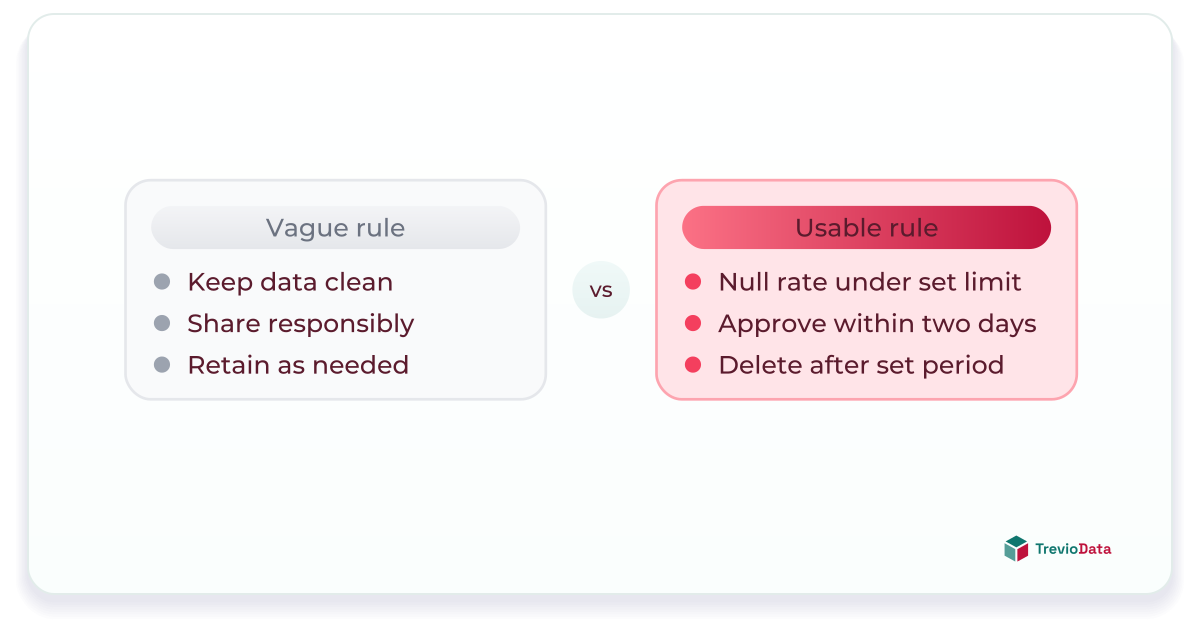
Policies work when they are short and tied to a task. A rule such as "every executive KPI has one written definition and one owner" is easy to follow and easy to check. A rule written as three pages of principles is not.
Start with four standards: definitions, quality, access and retention. For each, say what the rule is, who checks it and what happens when it is broken. Leave legal interpretation to your legal team, and use their guidance to set sensitivity levels and retention periods. Because requirements change, confirm the current rules that apply to you before you publish a standard.
Rules That Often Matter First
- Every executive KPI has one definition and one named owner.
- Every dataset with personal or confidential data has a sensitivity label.
- Every critical dataset has at least three automated quality tests.
- Every access request has a named approver and a response target.
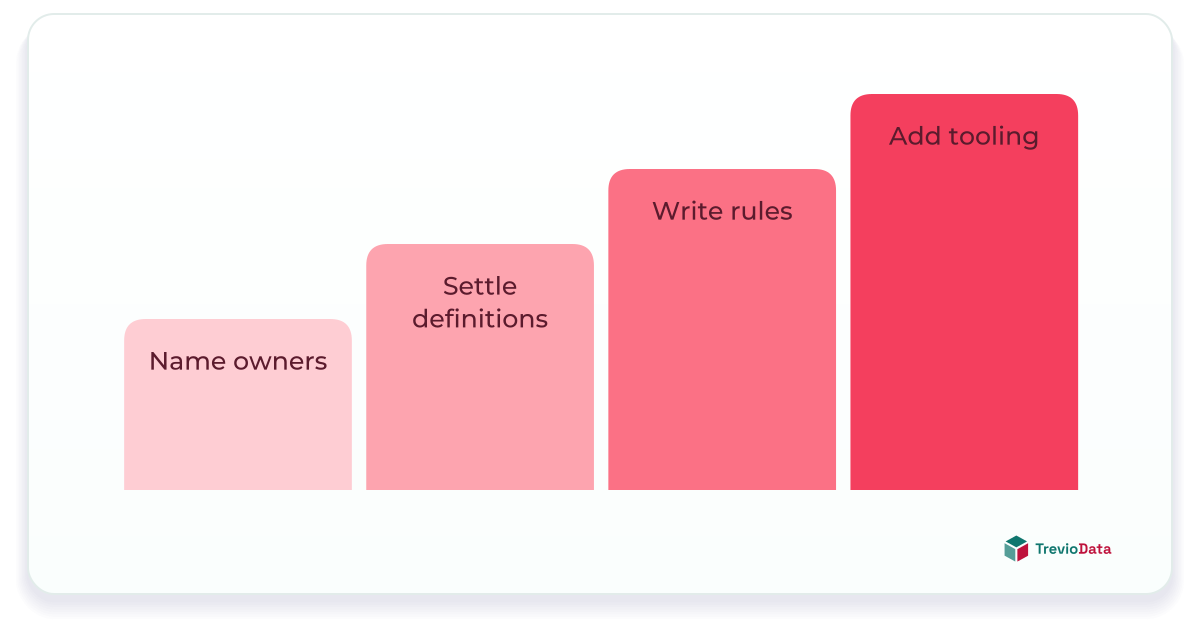
5. Buy Tools After You Have Something to Put in Them
A catalog without owners is an empty shelf. Decide roles and rules first, then pick tools that enforce them. If your data sits in Azure or Fabric, Microsoft Purview is a natural place to look. Teams on Databricks can start with Unity Catalog, and analyst-led teams often prefer a catalog such as Atlan. My ranking of data governance tools compares ten options, including free ones.
Count the full cost. Open-source tools remove license fees but need engineering time, and enterprise suites add implementation effort that can run for months. Write the cost range into the strategy so your sponsor sees it up front.
Common Ways a Strategy Goes Wrong
Three patterns repeat. The first is a strategy written by IT alone, which business teams ignore. The second is a long policy library with no owners to apply it. The third is a tool rollout presented as the strategy itself. Each one fails for the same reason: nobody with authority over the data agreed to follow the rules.
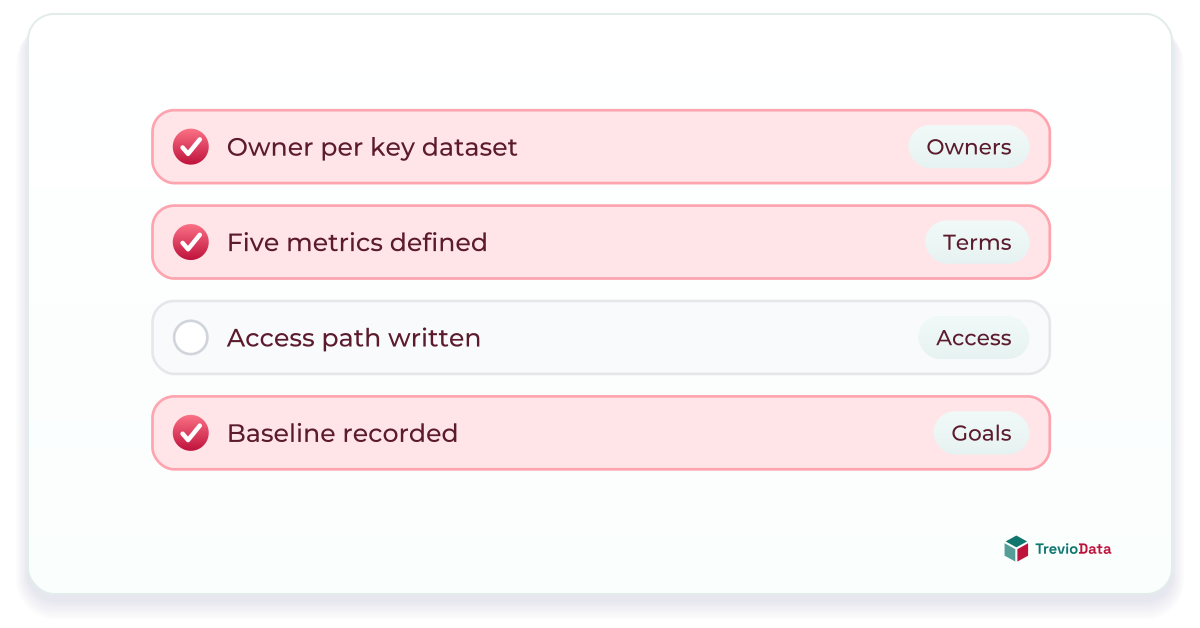
A quick test helps. Ask three business leaders who owns customer data. If you get three different answers, your strategy has not landed yet, and the fix is conversations, not documents. Repeat the test each quarter and watch the answers converge.
Revisit the strategy once a year. Goals change, owners move on and new data sources appear, so a short annual review keeps the document honest. Drop what no longer matters and add the next domain with the same scoring method.
6. Measure Four Things and Review Them Monthly
Pick a few measures that show whether decisions are being made and followed. Too many metrics become a reporting job of their own.
| Measure | How to calculate it | What a rise or fall tells you |
|---|---|---|
| Ownership coverage | Key datasets with a named owner divided by all key datasets | Rising means accountability is spreading |
| Access turnaround | Median days from request to decision | Falling means the approval path works |
| Disputed reports | Reports challenged in meetings each month | Falling means definitions are settling |
| Quality pass rate | Passed tests divided by all tests on critical data | Rising means fewer surprises downstream |
IBM's 2025 research puts a price on the risk side: the global average cost of a data breach was USD 4.44 million, and organizations with a high level of shadow AI paid USD 670,000 more on average. Governance will not remove that risk, but ownership, classification and access rules shrink the area you have to protect.
A First-Year Playbook, Quarter by Quarter
The strategy needs a sequence. I use four quarters, and my data governance roadmap breaks them into milestones you can copy.
| Quarter | Focus | Visible result |
|---|---|---|
| Quarter 1 | Goals, first domain, owners and five definitions | Disputed numbers settled for one domain |
| Quarter 2 | Access rules, sensitivity labels and quality tests | Faster, clearer access approvals |
| Quarter 3 | Catalog and lineage for the first domain | Search and trace instead of asking around |
| Quarter 4 | Second domain and a program review | Proven playbook ready to repeat |
Companies that did this well tend to look alike. The data governance examples I collected show teams that started with a small, visible win, then scaled, which supports the quarter-by-quarter pattern.
How to Choose Your Priorities When Everything Feels Urgent
Leaders often want governance everywhere at once. I give them a three-question filter and apply it to every request:
- Does it cost the business money or create risk today?
- Can a named owner act on it within a quarter?
- Can we measure the result?
Anything that fails two of the three questions waits. Share the waiting list openly, so teams see that their request is recorded and not ignored. If you want a second opinion on your priorities, a short call can usually settle them.
Questions About Data Governance Strategy
What Is a Data Governance Strategy?
A data governance strategy is a short plan that says why you govern data, which domains come first, who is accountable and how you will know it works. It links governance to business goals such as faster reporting, lower audit effort or safer AI use. A strategy fits on a few pages, and the daily rules live in separate policies and standards.
How Long Should a Data Governance Strategy Be?
Three to five pages is enough for most companies. It should state your goals, your first two domains, your operating model, your measures and the next ninety days. If it needs more, you are probably writing policies, and those belong in their own documents that owners can update without reopening the strategy.
Who Should Own the Data Governance Strategy?
An executive sponsor owns it, often the chief data officer, head of finance or head of operations. A governance lead runs it day to day, and domain owners carry out the rules. If nobody senior owns it, decisions stall the first time two teams disagree, so settle this before you write anything else.
Which Framework Should I Use?
Most teams borrow from established models such as DAMA-DMBOK, then simplify. A framework helps you check you have covered the basics, such as roles, policies, quality and metadata. Copying every element rarely helps. Pick the five or six parts that match your first problem and add the rest when you need them.
How Do I Get Business Teams to Take Part?
Tie governance to a pain they already feel, such as disputed reports or slow access. Ask them to write the definitions, keep meetings short and show the time saved after the first quarter. People join when their own work gets easier, and they leave when governance feels like paperwork.
How Much Does a Data Governance Program Cost?
Cost depends on the number of domains, the people involved and the tools. A first domain with owners, a glossary and a simple catalog can start small, and enterprise suites cost far more. Ask each vendor for a written three-year quote for the same scope, and count your own staff time as a real cost.
How Do I Know Whether the Strategy Is Working?
Track a short list of measures from day one: share of key datasets with an owner, time to approve access, number of disputed reports and quality test pass rate. Review them monthly with your sponsor. If two quarters pass without movement, change the plan rather than adding more policies.
Sources
Note: This article is general information, not legal, financial or tax advice. Figures and examples are estimates based on typical projects, so check current details with your providers and advisers before you decide.
Was this article helpful?
Thank you for letting us know.
Camille leads the Trevio editorial team and works with our consultants to turn real client projects into practical guides on data strategy, engineering and governance. Before joining Trevio, she spent 11 years in data engineering and analytics roles. She has since edited more than 300 articles on data management and reviewed pipelines and platforms from over 100 client projects. She is based in Denver, Colorado.