Key Takeaways
- The best governance examples name owners and agree on definitions before adding automation.
- Reported results range from 40% time savings to 50 days of work cut to 5 hours.
- Most figures come from vendor case studies, so check them against your own baseline.
- Start with the example that matches your biggest pain and can show a result within 90 days.
Data governance sounds abstract until you see what a company actually did. In this guide I walk through seven public examples with the action each team took, the result it reported and how you can copy the idea. If you are starting from scratch, my data governance consulting service builds the same foundations with your own teams.
Most of the numbers here come from vendor case studies, so I label them that way. They show what is possible rather than what you will get. Use them as a checklist of practices to test, and measure your own baseline before you start.
Seven Data Governance Examples You Can Learn From
The table lists each company, what it did and the result it reported. Each section below explains the idea and gives you steps to copy it.
| Company | Governance action | Reported result |
|---|---|---|
| 1. Chargebee | Self-service data hub | Half again more requests handled without the data team |
| 2. Tide | Personal data discovery | 50 days of work cut to 5 hours |
| 3. Porto | Automated governance | 40% time saving for the governance team |
| 4. Mastercard | Steward-led enrichment | Over 6,000 hours saved |
| 5. General Motors | Governing data before production | A $1 billion warranty opportunity identified |
| 6. Autodesk | Data mesh with ownership | 60 domain teams with visibility into their data products |
| 7. Airbnb | Data literacy program | No public figures I could verify |
Chargebee
Chargebee set up a central self-service hub for its enterprise data, so employees could find and use data without filing a request each time. According to Atlan's published case, the company offloaded 50% more data requests to self-service users than it expected, and resolution time for data requests fell by 90%.
If you recognize the pattern of analysts answering the same questions every week, this is the example to study. The governance work is the boring part: agreeing on which datasets are certified, who owns them and where the definitions live. The hub only works once people trust what they find there. In my client work, teams that skip the certification step end up with a catalog that nobody opens.
How to Copy This Setup
- List the ten questions your data team answers most often.
- Name an owner for each dataset behind those answers.
- Certify the datasets and write one-sentence descriptions.
- Put them in one searchable place and link it from your chat tool.
- Track how many requests still reach the team each week.
Tools Behind a Self-Service Hub
Chargebee used Atlan for its hub. Any catalog with search, certification badges and ownership fields can do the job, including OpenMetadata and Microsoft Purview.
Tide
Tide used Atlan to identify and secure personal data as part of its GDPR compliance work. The company reports that work which would have taken 50 days was reduced to 5 hours.
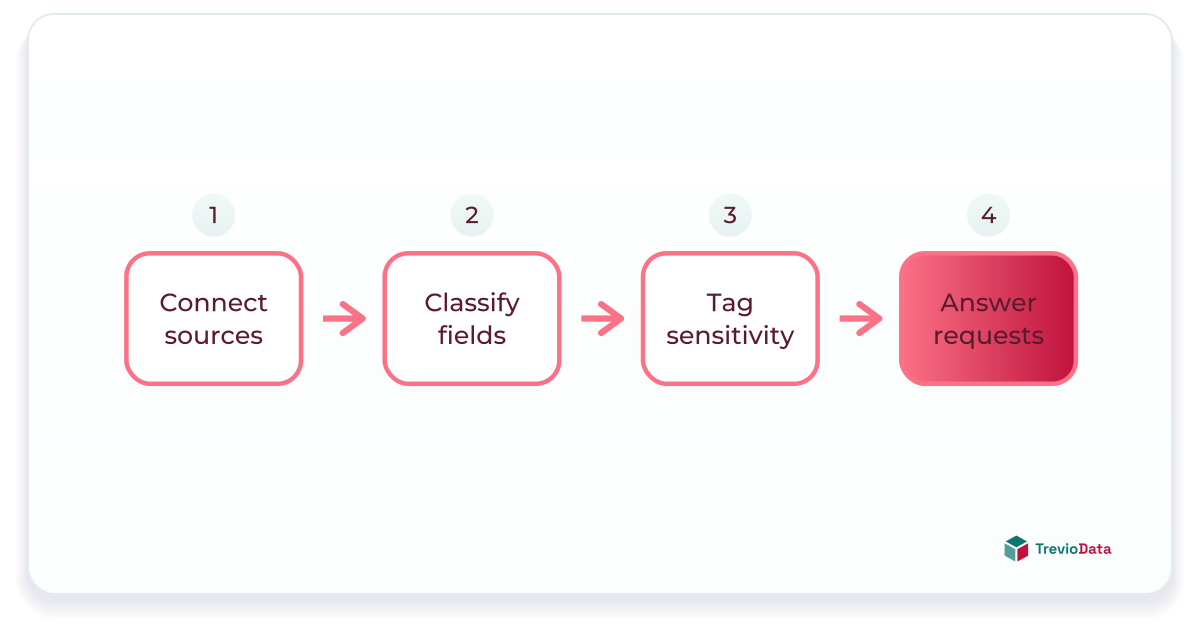
The lesson for you is where the saving comes from. Automated classification found personal data across systems, and tags then carried through to downstream assets, so nobody had to inspect tables by hand. Governance gave the tags their meaning, because someone had to decide what counts as personal data and how it must be handled. Treat the headline number as vendor-reported and expect your own result to depend on how messy your sources are.
Steps to Find Personal Data Faster
- Agree on a short list of personal data types.
- Connect your main databases and warehouses to a catalog.
- Run automated classification and review a sample by hand.
- Propagate approved tags to downstream tables and reports.
- Assign an owner to every tagged dataset.
- Repeat the scan on a schedule, so new tables are caught.
Tools for Classification
Tide used Atlan. Purview, Collibra, Informatica and Ataccama all offer automated classification, so check which one reads your sources natively.
Porto
Porto automated its data governance, and Atlan reports a 40% time saving for its governance team. The company moved routine work such as tagging, propagation of classifications and documentation checks out of spreadsheets and into automation.
Governance teams are usually small, and manual upkeep eats their week. The practical takeaway is to count how many hours your stewards spend on repeat tasks before you plan any new policy. Every hour you automate goes back into the work that needs judgment, such as resolving disputes about definitions or approving sensitive access.
How to Automate the Routine Work
- Log what your stewards do in a typical week.
- Mark the tasks that follow fixed rules.
- Turn those rules into automated playbooks or tag propagation.
- Keep a human review step for sensitive classifications.
- Compare hours before and after, then pick the next task.
What You Will Need
Porto used Atlan automation. Most modern catalogs include rule-based tagging, and Unity Catalog or Purview can enforce access policies near the data.
Mastercard
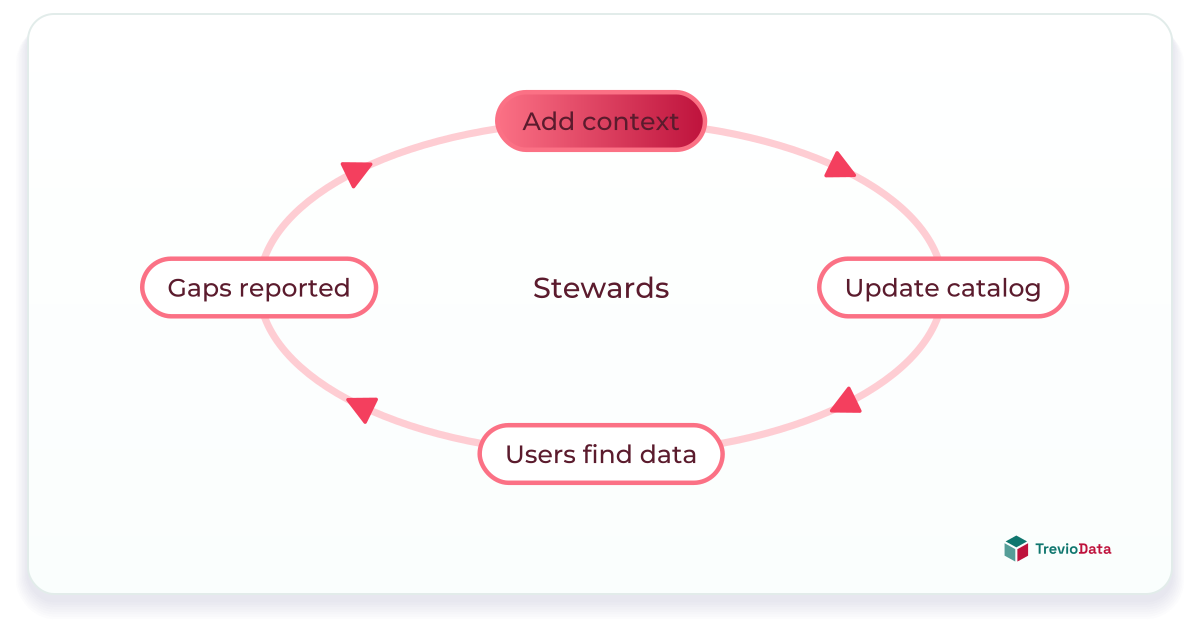
A data steward at Mastercard enriched more than 30,000 of the company's 100M+ assets in Atlan, which Atlan says saved over 6,000 hours. The figure shows what happens when one accountable person works with tooling that spreads descriptions and tags across related assets.
The honest caveat is that 30,000 is a small slice of 100M. Nobody documents everything, so the choice of which assets to enrich first decides the value. I advise teams to start with the datasets behind executive reports and regulatory submissions, then widen out once usage data shows what people actually search for.
Steps to Enrich the Assets That Matter
- Rank assets by how many reports and users depend on them.
- Give one steward time each week for the top group.
- Write descriptions, owners and sensitivity tags.
- Let automation copy the metadata to related assets.
- Review search logs monthly to pick the next batch.
Tooling Notes
Mastercard used Atlan. Alation and Collibra offer similar stewardship workflows, and an open-source catalog works if you have engineers to run it.
General Motors
General Motors governs data before it reaches production, with Atlan acting as its context layer. Atlan reports that the work identified a $1 billion warranty opportunity and cut the effort for each later AI agent by 45% to 60%.
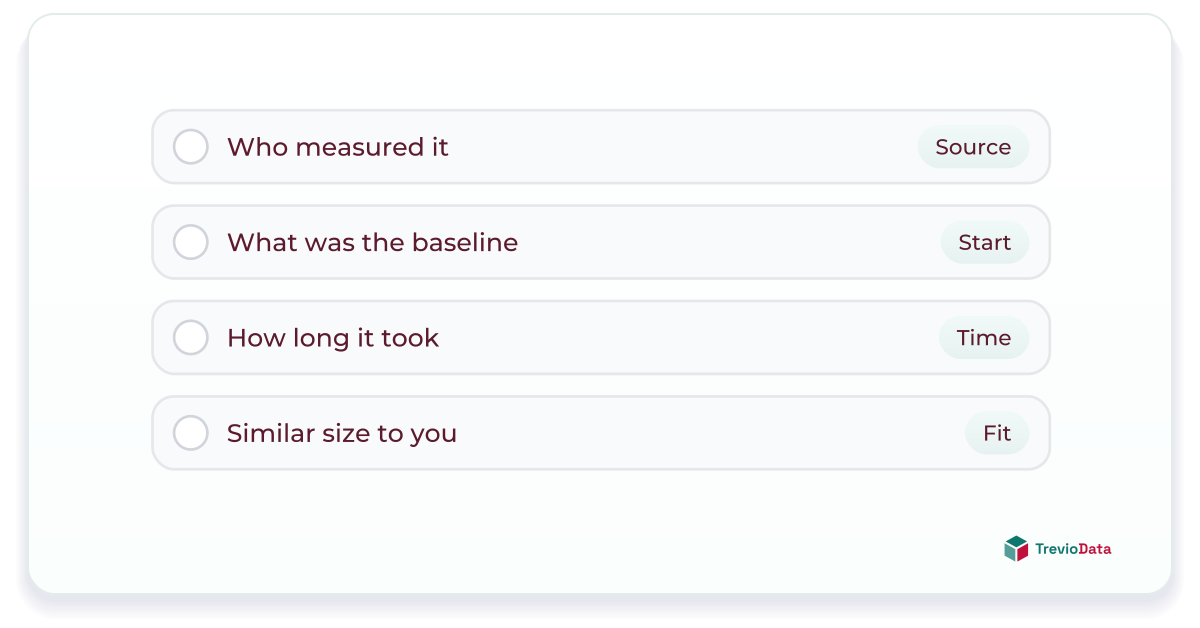
These are large, vendor-reported numbers, so read them as direction rather than a benchmark. The pattern is still worth copying: define and approve data before models consume it, then reuse that approved context for every new use case. The second and third projects get cheaper because the definitions and ownership already exist.
How to Govern Data Before It Ships
- Define a gate that new datasets pass before production use.
- Check ownership, quality rules and sensitivity at the gate.
- Store the approved definitions in your catalog.
- Reuse those definitions for every new model or report.
- Track how long each new project takes compared with the first.
Where This Lives in Your Stack
General Motors uses Atlan for this. A governed catalog plus quality checks in your pipelines gives you the same gate with Purview, Dataplex or Unity Catalog.
Autodesk
Autodesk built a self-service data mesh on Snowflake and Atlan, and by the time the case was published, 60 domain teams could see how their data products were consumed. According to the case, 45 use cases moved through the initiative from 2021, and the platform team had 120 active Atlan users when the company selected it in 2022.
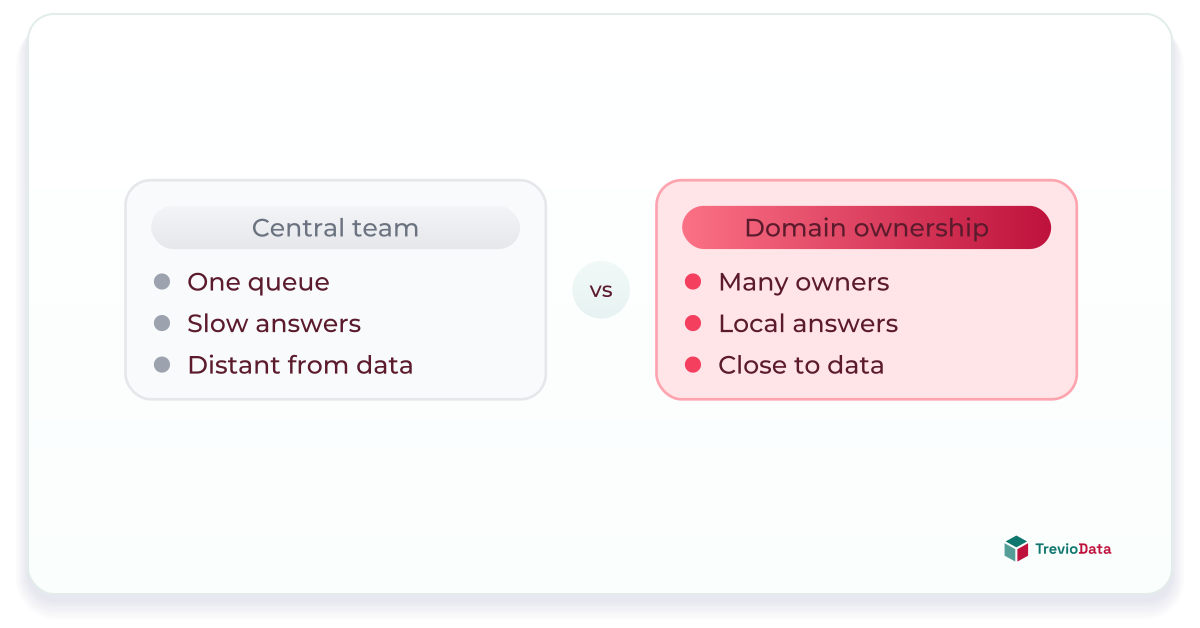
A mesh only works when each domain owns its data, and ownership needs governance behind it: shared standards, a catalog everyone uses and visibility into who consumes what. If you are thinking about domain ownership, use Autodesk as the example of how long it takes. Years of steady work stand behind those numbers.
Steps Toward Domain Ownership
- Pick two domains with willing owners.
- Agree on shared standards for naming, quality and publishing.
- Give each domain a view of who uses its data.
- Document what you learn and extend to the next domain.
- Review the standards every quarter.
Tools for a Domain Model
Autodesk combined Snowflake and Atlan. Databricks users can do the same with Unity Catalog, and Google Cloud users with Dataplex.
Airbnb
Airbnb ran an internal Data University to teach employees how to work with data. Atlan lists it among its governance examples, but I found no published numbers, so treat it as a practice rather than a proven result.
Governance fails when people do not know the rules exist. Training closes that gap, and it costs far less than a new tool. Your version can be small: short, role-based sessions on where certified data lives, how to request access and who to ask when numbers disagree.
Steps to Start a Data Literacy Program
- Choose three roles that use data every week.
- Write a one-page guide for each role.
- Run a 45-minute live session and record it.
- Add the guide to your catalog's landing page.
- Ask attendees which questions are still unanswered.
Tools You Can Use
Airbnb built this in-house. A shared wiki, your catalog's landing page and a recorded session are enough to start.
What the Strongest Examples Have in Common
Look across the seven and the pattern is plain. Every team named who owns the data, wrote down what it means and made the answer easy to find. The savings in Tide and Mastercard come from automation that spreads decisions people already made, which is why you need those decisions first.
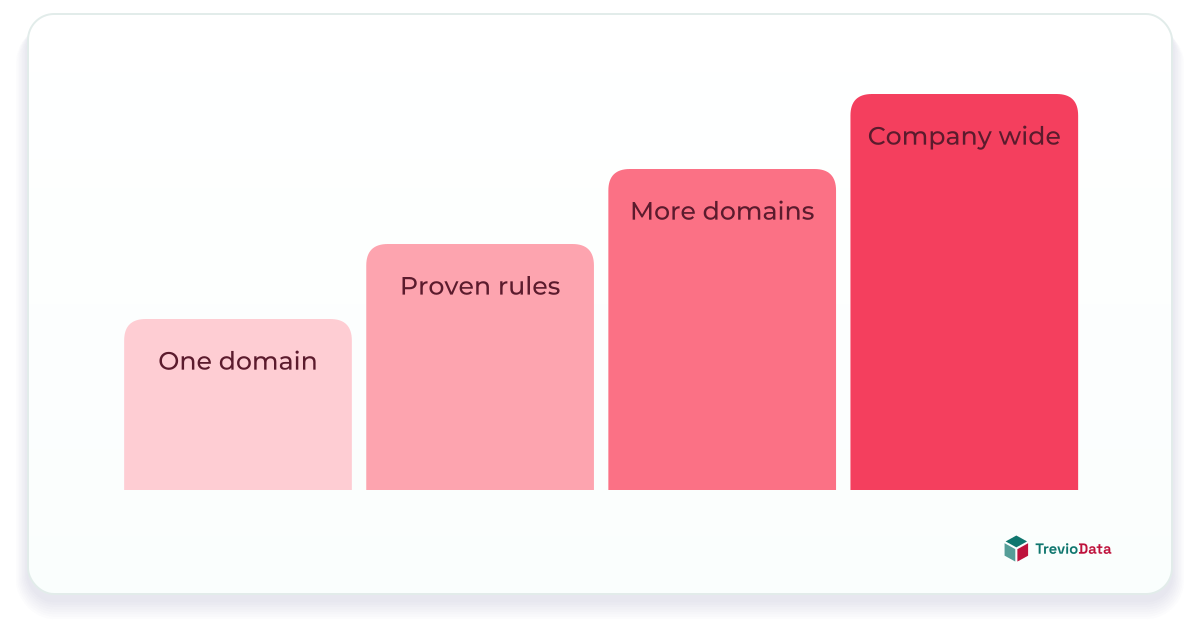
A second pattern is scope. Nobody governed everything at once. Mastercard enriched a slice of its assets, and Autodesk grew domain by domain. If you want a staged plan, my data governance roadmap shows the milestones I use, and the data governance strategy guide helps you choose which domain goes first.
How to Choose Which Example to Copy First
Pick the example that matches your biggest pain today. If analysts drown in requests, copy Chargebee. If auditors ask where personal data lives, copy Tide. If your team spends its week on repeat tasks, copy Porto. A short checklist helps:
- You can name the owner of the dataset involved.
- You can measure the baseline today, such as hours or request time.
- The work can show a result within about 90 days.
- You have a sponsor who cares about the outcome.
Once you have a shortlist, my ranking of data governance tools compares the platforms behind these examples. To see more scenarios beyond these companies, browse the data governance use cases I rank by return.
Questions About Data Governance Examples
What Is a Good Example of Data Governance?
A good example is a company that names an owner for each key dataset, agrees on one definition for core metrics and publishes both in a catalog people use. Chargebee's self-service hub and Autodesk's domain model both follow that pattern. The tool matters less than the owners and rules behind it.
How Do I Know Whether Governance Is Working?
Track a few numbers from the start: share of key datasets with a named owner, time to approve an access request, count of disputed reports and quality test pass rate. Review them monthly. If the numbers do not move after a quarter, the rules or owners need work.
Are the Results in These Examples Reliable?
Most figures come from vendor-published case studies, so they are marketing claims until you test them. Treat them as ranges worth checking against your own baseline. I flag where a source gives no numbers at all.
Which Example Is Easiest to Copy First?
The self-service hub and the data literacy program are the easiest, because they need little engineering. Personal data discovery and steward-led enrichment come next. Governing data before production and a full domain model take more planning and executive support.
Do Small Companies Need Data Governance?
Yes, in a lighter form. A small company can list its key datasets, name an owner for each and write down definitions in a shared document. That takes days, not months, and prevents most arguments about numbers.
How Long Do Governance Results Take to Show Up?
Small wins such as a certified dataset list or faster access approval can show up in weeks. Larger shifts, like the domain model at Autodesk, take years. I suggest planning for a first visible result inside 90 days.
Do I Need Atlan to Get These Results?
No. These examples used Atlan, but the practices apply to any catalog or governance tool. Pick the platform that fits your stack and budget, and focus first on owners, definitions and review habits.
Sources
Note: This article is general information, not legal, financial or tax advice. Figures and examples are estimates based on typical projects, so check current details with your providers and advisers before you decide.
Was this article helpful?
Thank you for letting us know.
Camille leads the Trevio editorial team and works with our consultants to turn real client projects into practical guides on data strategy, engineering and governance. Before joining Trevio, she spent 11 years in data engineering and analytics roles. She has since edited more than 300 articles on data management and reviewed pipelines and platforms from over 100 client projects. She is based in Denver, Colorado.