Key Takeaways
- A framework has seven layers, from domains and data model to metrics.
- Rules and ownership decide quality, and technology comes late in the model.
- Pick an architecture style that matches how many teams edit your records.
- Test every layer on one domain before you repeat it for the next.
People use the word framework for slide decks, vendor diagrams and checklists. In practice, a master data management framework is a model you can run: it says what a master record is, who decides, how duplicates are found and how clean data returns to your systems. When I start a master data management consulting engagement, I walk the client through the same seven layers, in the same order.
This guide explains the model, shows how the layers depend on each other and closes with a checklist you can use on your own first domain.
What a Master Data Framework Actually Covers
Master data describes the core things your business runs on: customers, products, suppliers, locations and sometimes assets or employees. It changes slowly and many systems use it. Transactions, such as orders and invoices, refer to master data but are not part of it. That difference matters, because master data is the thing you share and transactions are the thing you record.
A framework organizes the work around that shared data so it does not depend on one person's memory. It sits below your master data management strategy, which explains why you are doing the work, and above the build tasks that the master data management implementation guide describes.
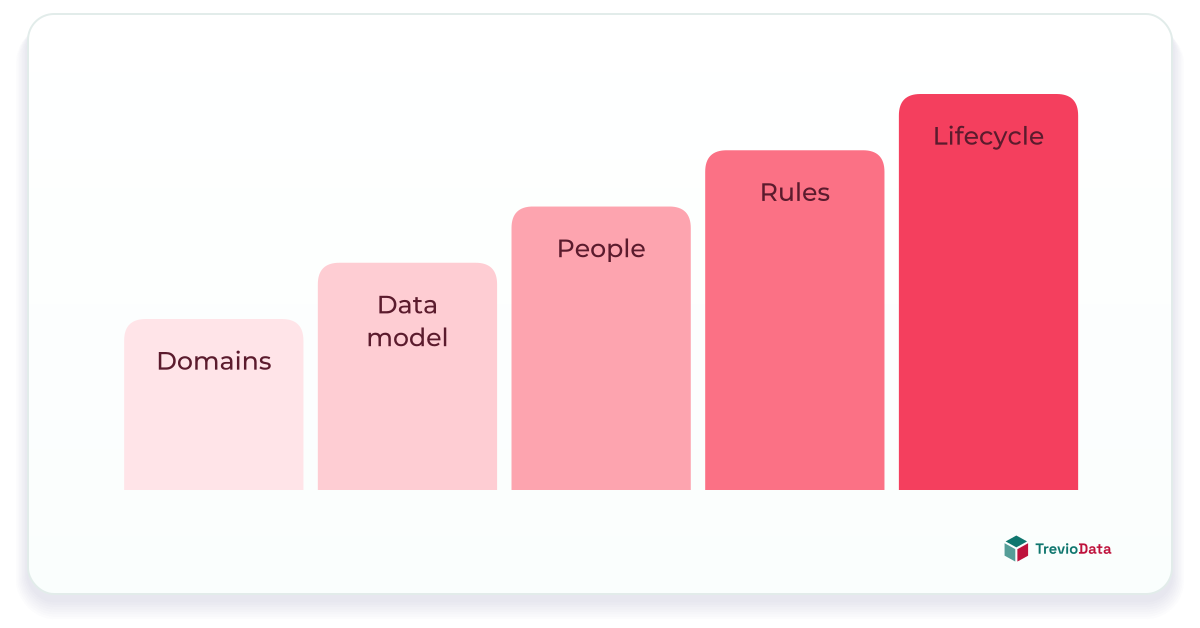
The Seven Layers at a Glance
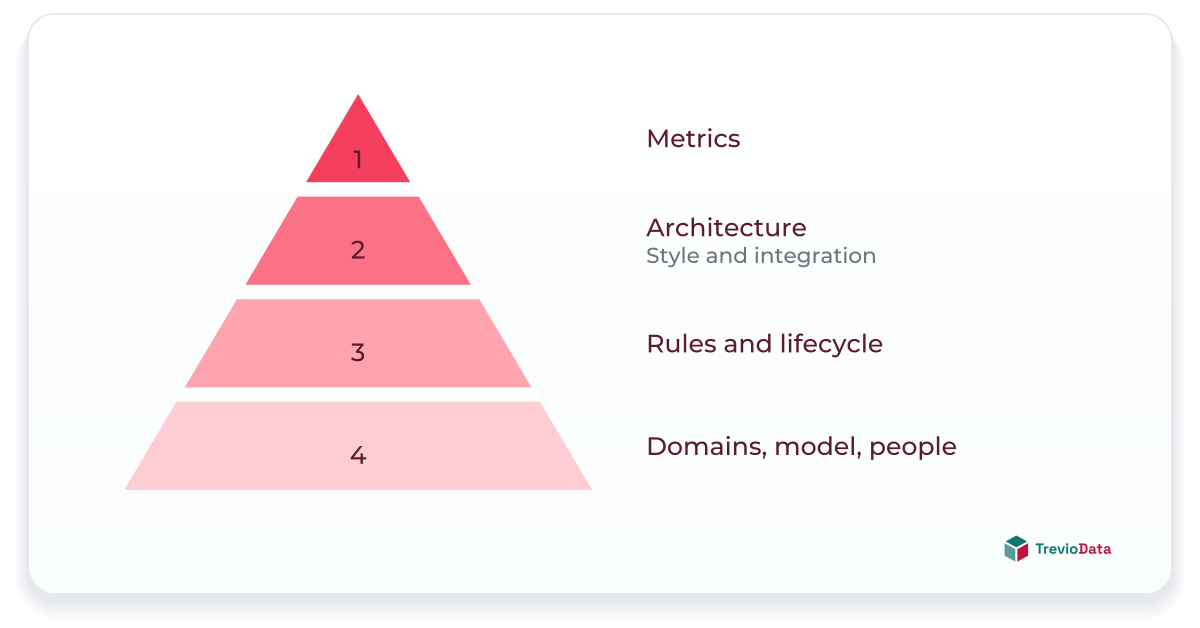
| Layer | Question it answers | Main artifact |
|---|---|---|
| 1. Domains | Which entities do we master? | Domain list with priorities |
| 2. Data model | Which attributes make up a record? | Attribute catalog and formats |
| 3. People | Who decides and who fixes? | Owner, steward and custodian roles |
| 4. Rules | When are two records one, and which value wins? | Match and survivorship register |
| 5. Lifecycle | How is a record created, changed and retired? | Workflow with approvals |
| 6. Architecture | Where does the golden record live and how does it travel? | Style choice and integration map |
| 7. Metrics | Is it working? | Monthly scorecard |
Step by Step Through the Model
Step 1: Choose the Domain
Start with one domain. List customers, products, suppliers and locations, then rank them by the cost of bad records and the number of systems that create them. The domain with high cost and few sources goes first. The wider decision logic sits in the strategy guide, and the payoffs per domain are in my master data management use cases.
Step 2: Define the Data Model
List every attribute a record needs, mark which are mandatory and fix the formats. A customer record might need legal name, trading name, country, tax ID and a billing address, plus a persistent identifier that never changes. Keep the model as small as the use cases allow. Every extra field is a field someone must maintain.
Add reference data at this point, such as country codes and industry classifications. Shared reference lists remove a surprising share of mismatches before you start matching.
Step 3: Assign People
Give each domain a business owner, a steward and a technical custodian. The owner decides policy, the steward works the queue and the custodian runs systems and integrations. Write the escalation path too, so a disagreement between two stewards has an answer.
Step 4: Write Match and Survivorship Rules
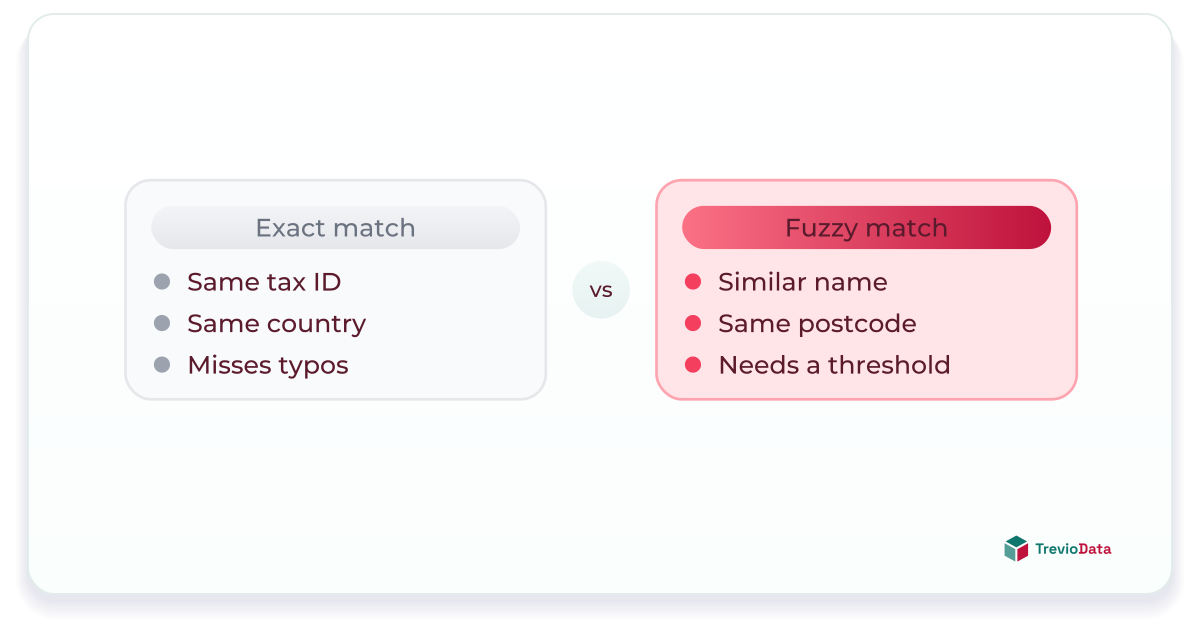
Match rules decide when records describe the same entity. Start with deterministic rules, such as an equal tax ID, then add fuzzy rules on name and address with thresholds. Survivorship rules decide the winning value for each field: most recent, most trusted source or most complete.
| Rule type | Example | Risk if wrong |
|---|---|---|
| Exact match | Same tax ID and country | Low, but misses typos |
| Fuzzy match | Name similarity above a threshold and same postcode | Wrong merges if the threshold is low |
| Source trust | Billing address from ERP wins over CRM | Stale values if the trusted source is not updated |
| Recency | Latest verified phone number wins | A careless edit overwrites a good value |
Test on a sample of real records before scaling. A rule register with one example pair per rule gives stewards something to learn from and auditors something to read.
Step 5: Design the Record Lifecycle
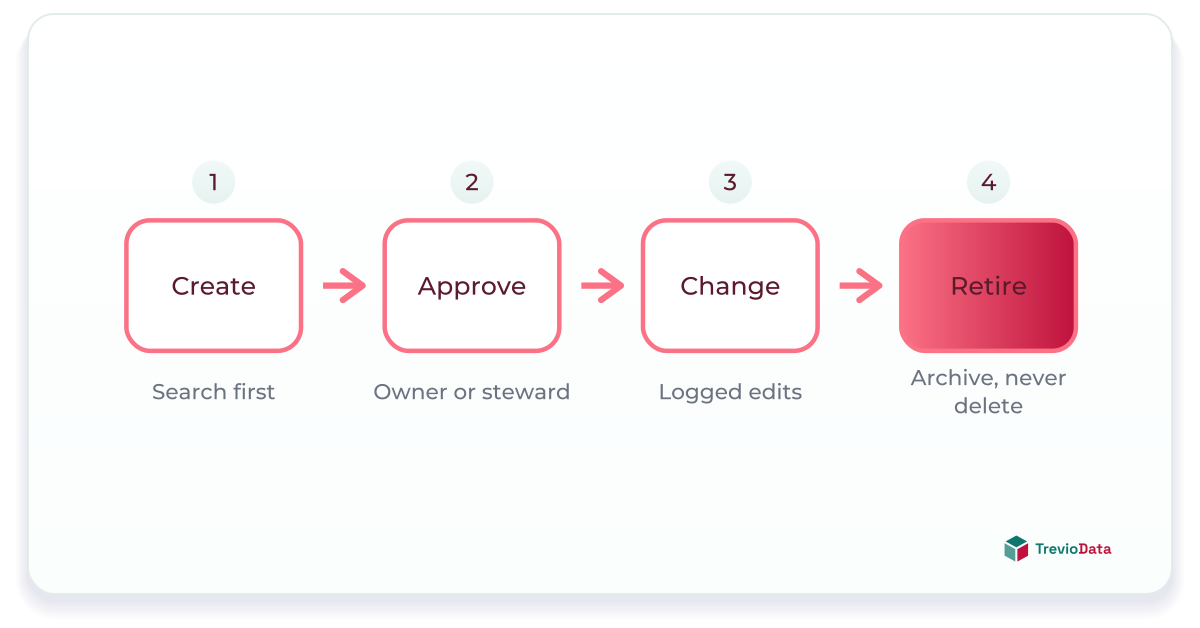
A record is born, changed and eventually retired. Map each stage: who can create it, which checks run, who approves changes to sensitive fields and what happens when a customer or supplier is no longer active. Search-before-create at the first step prevents most duplicates. Retire records instead of deleting them, so history and audit trails survive.
Step 6: Pick the Architecture Style
Four styles exist, and each answers a different question about where the truth lives.
| Style | Where records are edited | Best for |
|---|---|---|
| Registry | Source systems only | A fast read-only view without changing sources |
| Consolidation | Source systems, with a hub for reporting | Trusted analytics |
| Coexistence | Hub and sources, synced both ways | Teams that keep their own tools |
| Centralized | Hub only | Domains with one realistic entry point |
Only after this choice should you evaluate tools. My ranking of master data management software is organized around exactly these fit questions.
Step 7: Set the Metrics
Pick three to five measures and baseline them before launch: duplicate rate, completeness of mandatory fields, time to create a record, steward queue age and one cost measure from your business case. Report them monthly to the domain owner. The habits that keep these numbers moving the right way are covered in my master data management best practices.
A Worked Example: Customers at a Mid-Sized Distributor
To show how the layers fit together, here is a composite example based on patterns I see in distribution and retail clients. A distributor keeps customers in an ERP, a CRM and a web shop. Sales counts 11,400 accounts, finance counts 9,800 and the shop has 14,200 registered users. Nobody can say how many customers they have.
Layer one picks customers, because duplicate accounts cause double credit checks and mixed pricing. Layer two defines a customer as a legal entity with one or more ship-to addresses, which settles the argument between sales and finance. Layer three names the head of sales operations as owner and two order-desk staff as stewards. Layer four matches on tax ID first and on fuzzy name plus postcode second, and finance's billing address wins over the CRM's. Layer five adds a search-before-create step to the web shop registration and the CRM account form. Layer six chooses coexistence, because sales will not give up the CRM. Layer seven records the baseline: a duplicate rate and the number of invoices sent to outdated addresses.
None of this needs a vendor name. Once the artifacts exist, the tool choice becomes a question of fit, and a proof of concept on the distributor's own messy accounts answers it.
How the Layers Depend on Each Other
The layers are not independent boxes. A change in one forces a review of others, and knowing the links saves rework.
- A new attribute in the data model needs a survivorship rule and a place in the lifecycle form.
- A new source system changes the match rules, because each system has its own formats and identifiers.
- A move from consolidation to coexistence changes the lifecycle, the roles and the metrics, since editing now happens in two places.
- A change in owner means the rule register should be reviewed by the new person, not inherited unread.
I suggest you keep one living document for the seven artifacts and review it every quarter. When something breaks, the document tells you which layer to look at first. It also helps new stewards, who otherwise learn the rules from whoever sits next to them.
Where Governance Fits Around the Framework
Governance sets the policies that the framework implements: who may see which fields, how long records are kept and what quality level is acceptable. The framework turns those policies into rules, roles and workflows for the entities you master. If you have no governance function yet, you can start with a domain owner who acts as a one-person council. Companies that want a wider program can look at data governance consulting, but you do not have to wait for it before you start mastering one domain.
Where Frameworks Break Down
Frameworks usually fail in layers three and four. Roles exist on paper while stewards have no time, or rules grow so complex that nobody can explain a merge. A second failure is skipping layer five, so records keep entering through forms that nobody changed. A third is building layer six before layers one to five, which gives you a platform and no agreement on what it should hold.
When I review a stalled program, I walk the seven layers and ask for the artifact of each. The first missing artifact is where the work restarts, and it is almost never the technology.
A Checklist to Apply the Model to Your First Domain
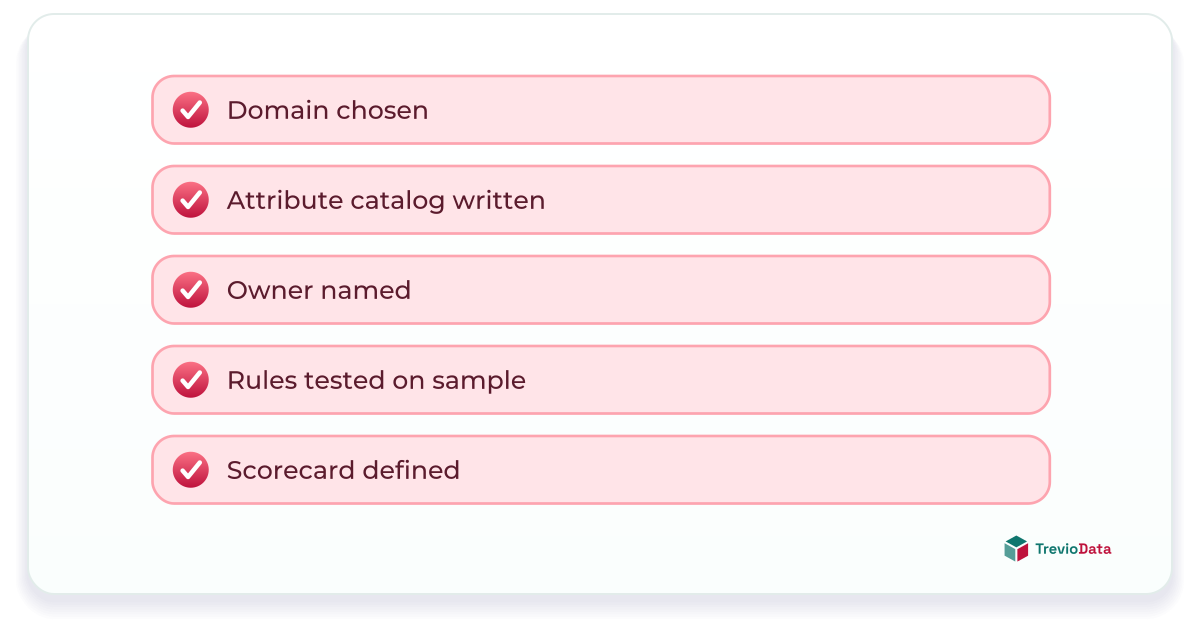
Before you start building, confirm that you can produce each of these. If one is missing, that is your next task:
- A ranked domain list and a named first domain
- An attribute catalog with mandatory fields and formats
- An owner, a steward and a custodian with time assigned
- A match and survivorship register tested on real records
- A lifecycle workflow with search-before-create
- An architecture style and an integration map for the first two systems
- A baseline and a monthly scorecard
Questions About the Master Data Management Framework
What Is a Master Data Management Framework?
It is the model that defines how master data is identified, matched, governed and shared across your systems. It has layers: the domains and data model, the people and rules, the process for creating and changing records, the technology and the metrics that show whether it works.
What Are the Components of an MDM Framework?
The core components are domains, a data model, ownership and stewardship roles, match and survivorship rules, a lifecycle process for creating and retiring records, an integration pattern, a technology platform and a metrics scorecard. Governance policy sits around all of them.
How Is an MDM Framework Different from an MDM Strategy?
A strategy says why you are doing MDM, which domain comes first and how you will fund it. A framework describes how the work runs day to day, with layers, roles and rules. You write the strategy once and revisit it yearly, while the framework is what stewards use every week.
Which MDM Architecture Style Should I Use?
Registry, consolidation, coexistence and centralized are the four common styles. Consolidation and coexistence suit most mid-sized companies. Centralized gives the cleanest data but changes how people work, so it suits domains with a single realistic entry point, such as suppliers.
Do I Need a Data Governance Program Before MDM?
You need ownership and decision rights for the domain you master, which is a light slice of governance. A company-wide governance program is helpful but not a precondition. Start with one domain owner and grow governance around the results.
How Many Data Domains Should a Framework Cover?
Design the framework to support several domains but build one first. The model, roles and metrics repeat across domains, so the second domain usually goes faster than the first.
Can I Use a Framework Without Buying MDM Software?
Yes. The framework is about decisions and process. A small company can run it with a warehouse, matching scripts and a steward workflow. Software becomes useful when several systems create the same records and you need audit trails and sharing back to applications.
Disclaimer: This article is general information, not legal, compliance or financial advice. Check the rules that apply to your data and industry.
Was this article helpful?
Thank you for letting us know.
Camille leads the Trevio editorial team and works with our consultants to turn real client projects into practical guides on data strategy, engineering and governance. Before joining Trevio, she spent 11 years in data engineering and analytics roles. She has since edited more than 300 articles on data management and reviewed pipelines and platforms from over 100 client projects. She is based in Denver, Colorado.