Key Takeaways
- Protect people's time and name a delivery lead before the first build starts.
- Settle definition disputes in two weeks with a tiebreaker, or they will eat a quarter.
- Profile source data before you commit to dates, and ship in releases of two to six weeks.
- Retire the old report on a set date, and budget a fifth to a third of build effort per year to keep things running.
The strategy gets approved, the kickoff goes well and then something odd happens. Three months later, half the milestones have slipped and nobody can say exactly why. Data strategy implementation fails slowly, through small delays that nobody owns. If you want a team beside you for the delivery stage, data strategy consulting can cover it from planning through monthly reviews.
Below are the delays I see most often, the stage where each one hits and what I do about it. I have grouped the work into five stages with steps for each. Where a delay has a clear cost, I say so in my own client experience, since published benchmarks vary widely.
Five Stages and Where They Slip
The table maps each stage to its usual delay and the early signal that shows it. Print it and tick off the signals in your weekly check-in.
| Stage | Typical delay | Early signal | First fix |
|---|---|---|---|
| 1. Mobilize | Sponsor and team time not protected | Kickoff slides, no calendar holds | Block time and name a delivery lead |
| 2. Foundations | Definition disputes drag on | Same metric debated for three meetings | Set a tiebreaker and a deadline |
| 3. First releases | Source data is worse than expected | Build time spent on fixing inputs | Profile data before committing dates |
| 4. Adoption | Users keep their old spreadsheets | Dashboard views fall after week two | Retire the old report on a set date |
| 5. Run and improve | No owner for fixes after launch | Open issues older than 30 days | Assign owners and a monthly review |
Stage 1: Mobilize the Team Before You Build Anything
The first delay is invisible: people agree in the kickoff and then have no time. Block their calendars before announcing the plan. Name a delivery lead whose job is to track the work, not do all of it. A half-time lead is a good starting point for a mid-sized company.
Steps That Prevent the Slow Start
- Confirm what percentage of time each named person can give for the next quarter.
- Agree who decides when two priorities clash, and write the name down.
- Hold a 45-minute kickoff that ends with each person stating their first task.
- Set a fixed weekly 30-minute check-in, with a rule that it never moves for another meeting.
Stage 2: Settle Definitions and Ownership Early
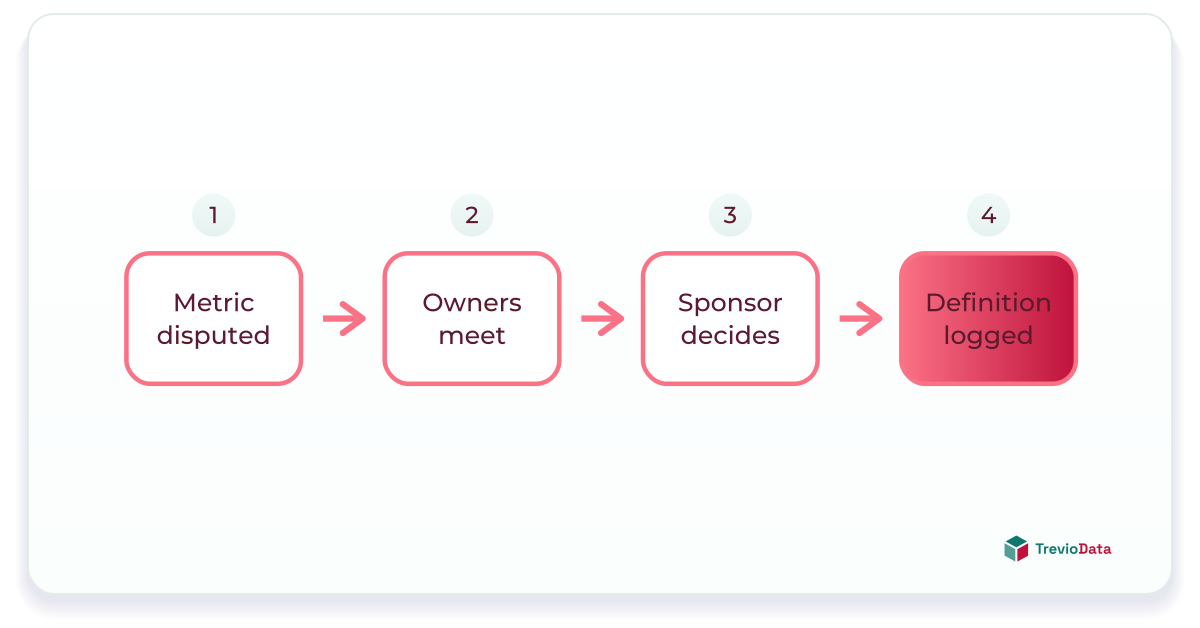
This is where the plan first meets politics. Sales counts a customer at signature, finance at first payment, and both are right in their own context. Left alone, that argument can eat a quarter. Give owners two weeks to agree, and if they do not, the tiebreaker decides and the decision log records it.
Link each definition to the report where it appears, so people see the effect right away. The approach follows the ownership step in my data strategy framework, and doing it early removes a common source of rework later.
Steps That Close Disputes Faster
- List the ten metrics people argue about most and rank them by report use.
- Draft one-sentence definitions with a worked example each.
- Put owners in a room for 60 minutes with the draft, and decide on the spot.
- Record the result in a shared log with a date and the decider’s name.
Stage 3: Ship Small Releases on Real Data
Source data is nearly always worse than the plan assumed. Fields are blank, codes are inconsistent and one system quietly overwrites another. If you commit to a date before profiling the data, you are committing to a guess. Run a quick profile of each source, covering row counts, blanks, duplicates and date ranges, in the first week of each release.
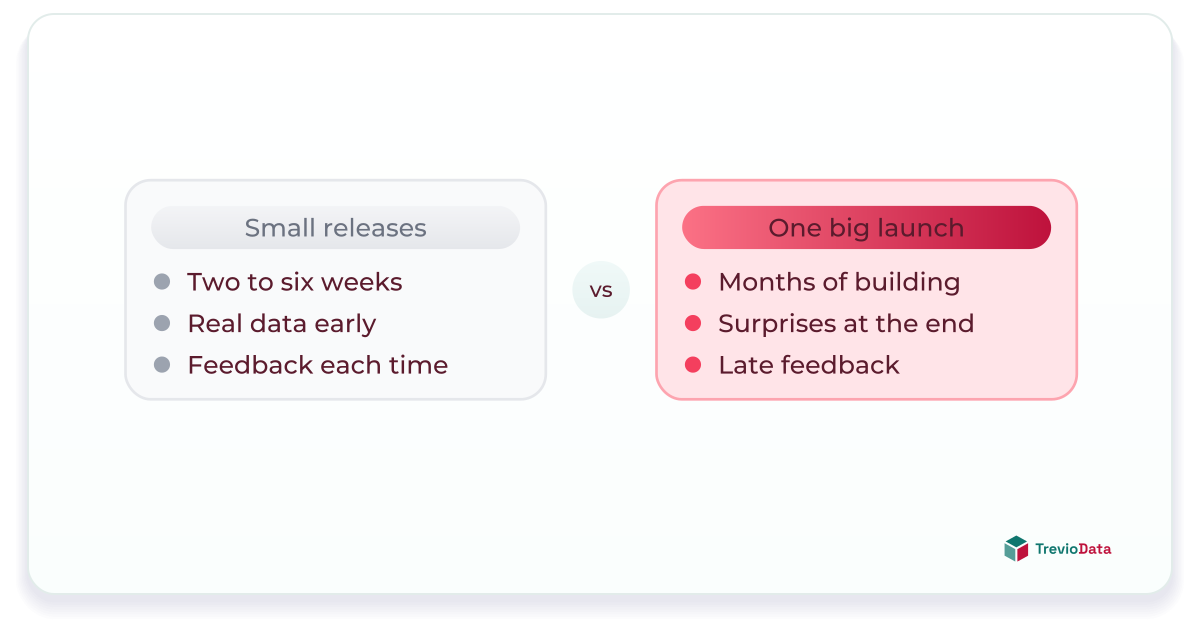
Release in pieces of two to six weeks. A small release that ships beats a big one that slips, and each release gives leaders something to see. When a delay does arise, you lose weeks instead of quarters. The data strategy roadmap shows how to space these releases across the first year.
Steps for a Dependable First Release
- Profile every source for blanks, duplicates and odd values before estimating.
- Agree what “good enough” means for the first release, in a sentence.
- Build the thinnest slice that answers one real question.
- Test with two real users using their own data, not sample data.
- Release, log what broke and plan the fix for the next release.
Stage 4: Make Sure People Actually Switch
A report nobody uses is an unfinished project. Adoption is the stage most teams underplan, and it is the one that decides whether leadership believes the strategy worked. Keep a simple count of weekly views or active users for each release and compare it to the number of people who were supposed to use it.
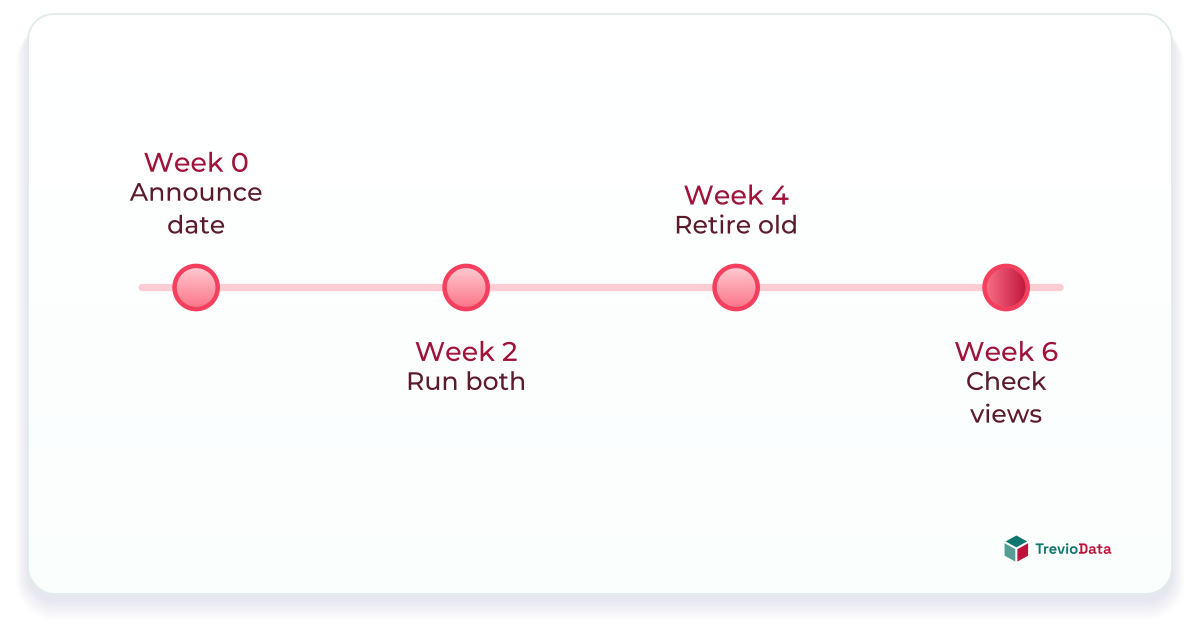
The strongest lever I have found is retiring the old way on a fixed date. Announce it a month ahead, offer a 30-minute walkthrough and switch off the old spreadsheet export. Without a date, people keep both versions and the old one wins out of habit.
Steps That Move People to the New Report
- Pick two champions per team who use the new report first.
- Run a short walkthrough using a question that team really asks.
- Set a retirement date for the old report and announce it a month ahead.
- Check usage after two weeks and call the ones who have not opened it.
Stage 5: Keep It Running After Launch
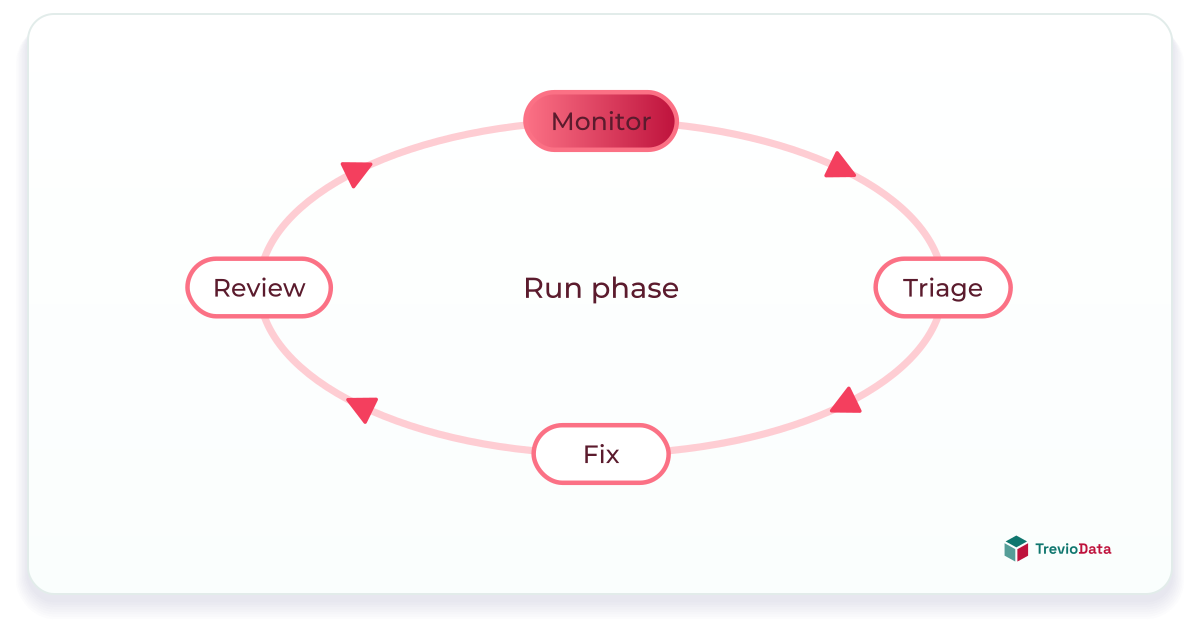
After launch, attention moves elsewhere and quality drifts. A source system changes a field name and a number quietly breaks. Assign an owner for every pipeline and report, set automatic checks on the key tables and review open issues monthly. The checks need not be sophisticated: a daily row count and a freshness alert catch most failures.
Budget for this. In my experience, run costs after launch settle at roughly a fifth to a third of the original build effort per year, depending on the number of sources. Teams that ignore that figure often find their first dashboards go stale within two quarters.
Document what you learn at the end of each stage in a half-page note: what went well, what slipped and what you would change. Those notes become the most useful input for the next stage and for the quarterly refresh of your plan.
The Four Root Causes Behind Most Delays
When I trace a late project back, the cause is almost always one of four things. People have no time, decisions have no owner, the data is a surprise or nobody is accountable after launch. Each stage above addresses one of them. If you track only four checks every week, track these: is the protected time still in place, are there open decisions older than two weeks, did the last data profile show new problems and does every live item have an owner.
Many problems appear first in a small company, where one person wears many hats. The simplified approach in data strategy for small business shows how to cut the stages down without losing the safeguards.
What Delays Cost, and How to Talk About It
Delays have a price that leaders understand. Count the people and weeks involved, multiply by their cost and add the cost of decisions made without the data in the meantime. I usually show a sponsor a single line: “each month of delay costs us about X in team time, plus Y in postponed decisions.” Even with rough numbers, it turns a vague status report into a case for action.
| Delay | Typical visible cost | Cheaper to prevent by |
|---|---|---|
| Two weeks lost to a definition dispute | Team time idle or reworked | Tiebreaker and deadline |
| A release rebuilt after bad source data | Several weeks of engineering | Profiling before estimating |
| Low adoption of a finished report | Build cost with no benefit | Retirement date for the old report |
| Stale data after launch | Lost trust, manual workarounds | Owners and automatic checks |
If you do not yet know your gaps, start with a data strategy assessment, which tells you in two or three weeks which of these delays you are most likely to hit.
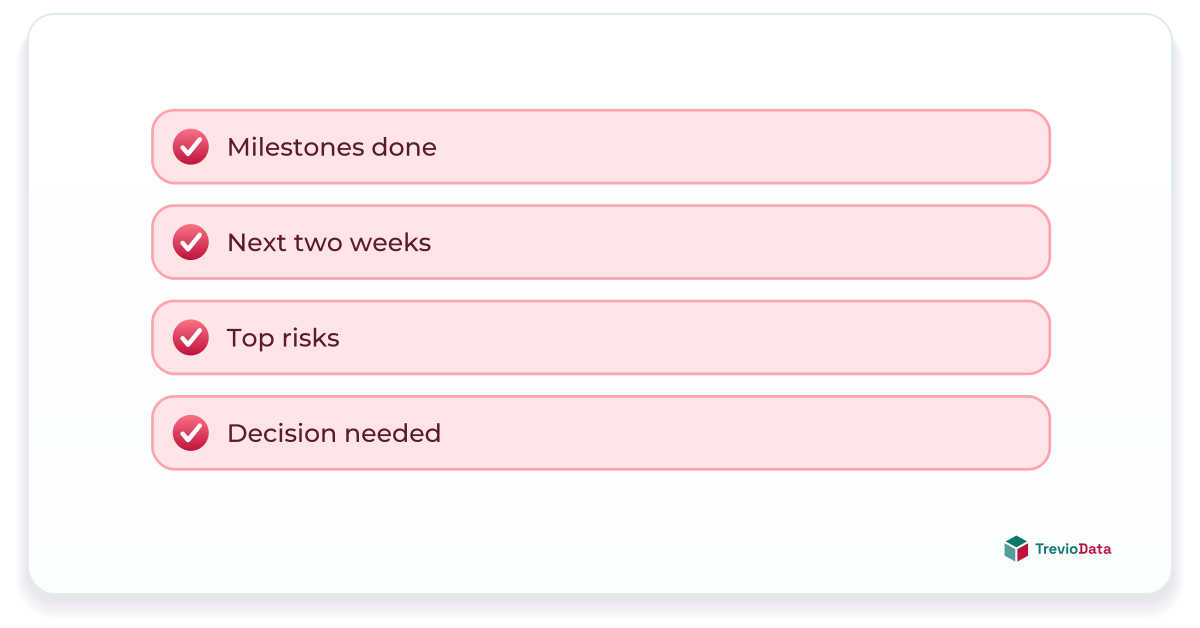
Finally, report status in a form leaders will read. I use a single page with three colored lines for each stage: done, at risk and blocked, each with an owner and a date. Anything blocked for more than a week goes to the sponsor, with the decision needed spelled out. That routine keeps small problems small and builds the trust you need when a larger one arrives.
How to Choose Who Runs Delivery
You have three options: your own team, a partner or a mix. Use your own team when you have people with protected time and experience of similar work. Use a partner when you lack capacity or want an outside voice to keep decisions moving. Use a mix when you want your people to learn while a partner carries the heavy build.
- Capacity: can named people give the hours the plan assumes?
- Experience: has anyone here shipped a similar release before?
- Neutrality: do you need someone outside the politics to settle disputes?
- Handover: will the partner leave documentation and train your team?
Whichever you choose, agree on the reporting rhythm before work starts. A weekly one-page status, with milestones, blockers and decisions needed, keeps surprises small.
Questions About Data Strategy Implementation
What Is Data Strategy Implementation?
It is the delivery stage that turns an approved data strategy into live reports, pipelines, owners and standards. It covers mobilizing the team, settling definitions, shipping releases, driving adoption and keeping everything running after launch.
Why Do Data Strategy Implementations Get Delayed?
The most common causes are protected time that never materializes, definition disputes without a tiebreaker, source data that is worse than assumed and no owner for fixes after launch. Most of them can be spotted a month early in your weekly check-in.
How Long Should Implementation Take?
A first release typically ships within two to three months, and a full roadmap takes 12 to 24 months depending on company size. Plan in small releases of two to six weeks so that delay in one does not stall everything.
Who Should Lead Implementation?
A delivery lead with a protected half of their time, reporting to an executive sponsor. The lead tracks the plan, clears blockers and runs the weekly check-in. The work itself stays with the domain owners and the data team.
How Do We Get People to Use the New Reports?
Pick champions in each team, show a walkthrough based on a question they really ask and set a date to retire the old report. Track weekly usage so you can follow up with the people who have not switched.
How Much Does It Cost to Run After Launch?
In my experience it settles at roughly a fifth to a third of the original build effort per year, depending on the number of sources. Include it in your budget from the start so your dashboards do not go stale.
When Should We Bring in Outside Help?
When you lack capacity, when decisions keep stalling or when you want your team to learn from someone who has shipped similar work. A mixed model, where a partner carries the build while your team shadows, works well for many companies.
Note: This article is general information, not legal, financial or tax advice. Figures and examples are estimates based on typical projects, so check current details with your providers and advisers before you decide.
Was this article helpful?
Thank you for letting us know.
Camille leads the Trevio editorial team and works with our consultants to turn real client projects into practical guides on data strategy, engineering and governance. Before joining Trevio, she spent 11 years in data engineering and analytics roles. She has since edited more than 300 articles on data management and reviewed pipelines and platforms from over 100 client projects. She is based in Denver, Colorado.