Key Takeaways
- A good data management strategy is a short plan that ties data work to business goals, with owners and dates.
- Rank problems by impact, pain and effort, and start with one domain instead of everything at once.
- Ownership and agreed definitions come before platforms, and they cost little.
- Review the plan every quarter and report results in the numbers your leaders already track.
Most companies already manage data. They just do it by habit: each team keeps its own spreadsheets, each tool holds its own copy and the people who know how it all fits together are busy. A strategy turns that habit into decisions. If you want a partner to help you write it, data management consulting usually starts with the same five phases below.
I wrote this playbook from the plans I have helped teams build and the ones I have seen fail. It is deliberately short in each phase, because the plans that work are the ones people finish.
The Five Phases in Short
Use the table to see where you are today. Most teams I meet have done a bit of phase four and skipped phases one and two, which is why their plans stall.
| Phase | Question it answers | What you produce | Typical time |
|---|---|---|---|
| 1. Business goals | What must data help us do this year? | Three to five goals with a measure each | 1 to 2 weeks |
| 2. Data inventory | What data do we have and where does it hurt? | Source list, owners, top problems | 2 to 4 weeks |
| 3. Priorities | What do we fix first? | A ranked list with scores | 1 week |
| 4. Ownership and rules | Who decides, and by which rules? | Owners, definitions, access rules | 2 to 6 weeks |
| 5. First project and reviews | How do we prove it works? | One delivered fix, a quarterly review | 1 to 3 months |
Phase One: Start From the Business Goals
Ask your leaders which three outcomes matter this year, then work backward to the data each one needs. If the goal is faster month-end close, you care about finance data and the pipelines behind it. If the goal is better campaign results, you care about customer records. Anything that does not trace back to a goal goes on a later list.
Write each goal with a measure you can check, such as days to close the books or the share of customers with a valid email. Without a measure you cannot say later whether the strategy worked.
Phase Two: Take Stock of What You Have
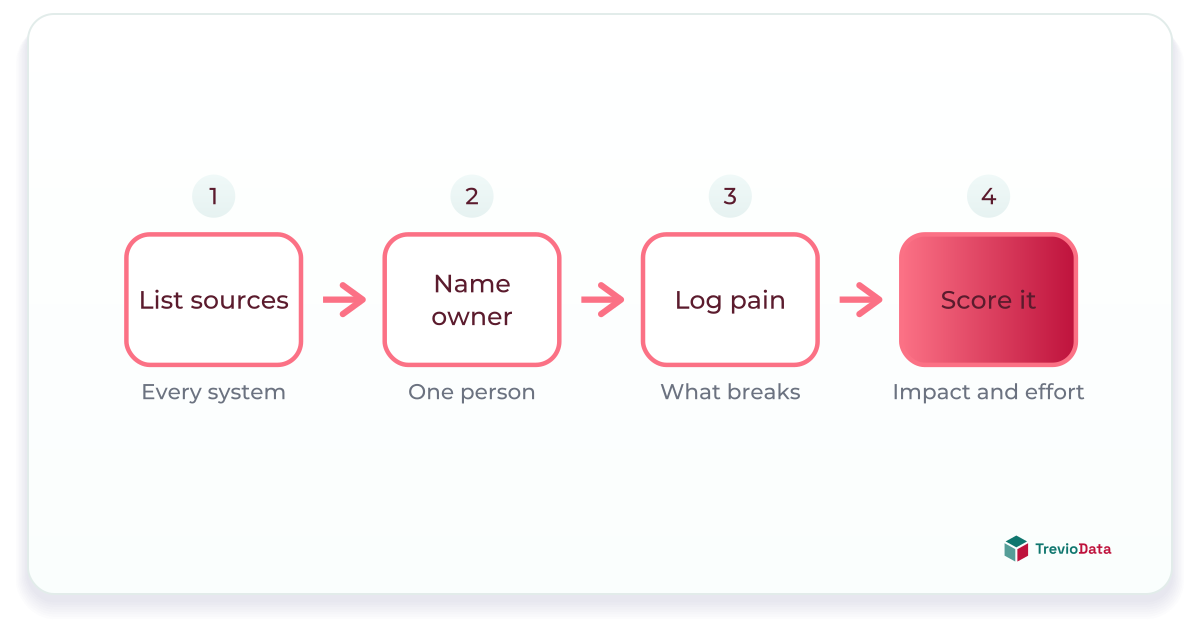
List your main sources: the CRM, billing, ERP, website, support desk and every spreadsheet that feeds a report. For each one, write down who owns it, where the data goes next and what usually goes wrong. This does not need a tool. A shared sheet and three workshops are enough for a first pass.
The inventory almost always shows surprises. A spreadsheet maintained by one person feeds the board report. Two systems hold different versions of the same customer. A nightly job has failed silently for weeks. Those findings are your raw material for priorities.
Research backs up what you will probably find. A study in Harvard Business Review, in which 75 executives scored 100 recent records from their own departments, found that on average 47% of newly created records had at least one critical error, and only 3% of scores were acceptable under even a loose standard (Harvard Business Review). Do not assume your own data is the exception.
Phase Three: Rank the Problems
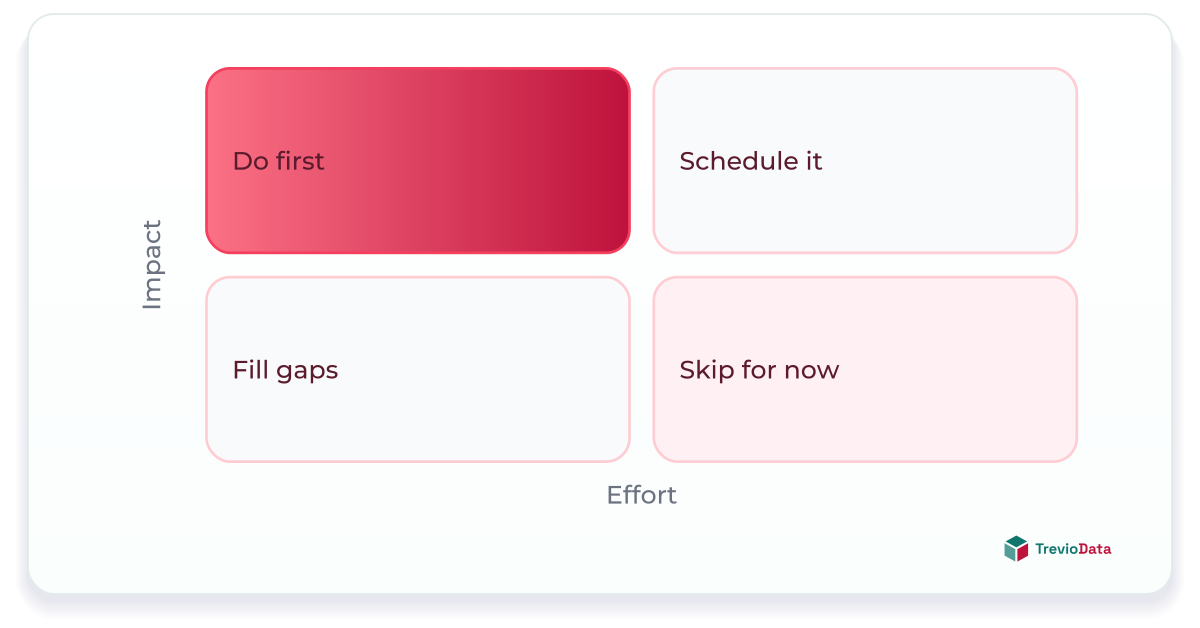
You will end up with more problems than time. Score each one on three questions, from 1 to 5: how much it costs you today (impact), how many people feel it (reach) and how hard it is to fix (effort). Then use a simple formula:
Priority score = (impact + reach) ÷ effort
A duplicate-customer problem that hurts sales and marketing and takes a few weeks to fix will score well above a platform migration that touches everything and takes a year. That is the point. Quick wins build the trust you need for the large projects.
| Problem | Impact | Reach | Effort | Score |
|---|---|---|---|---|
| Duplicate customer records | 4 | 4 | 2 | 4.0 |
| Failing nightly sales load | 5 | 3 | 2 | 4.0 |
| No owner for product data | 3 | 3 | 1 | 6.0 |
| Warehouse migration | 4 | 5 | 5 | 1.8 |
The scores above are an illustration of the method, not a benchmark. Use your own numbers, and have two or three people from different teams score together, because impact looks different from finance and from marketing.
Phase Four: Name Owners and Write Rules
This phase costs the least and changes the most. Give every important data domain, such as customers, products and finance, one owner who decides what the data means and who may use it. Add a steward who handles daily quality questions.
Then agree on definitions for your ten most argued-about metrics. Revenue, active customer and churn are the usual suspects. Write each definition in one or two sentences, publish it where people look and treat changes as decisions, not edits. Once owners exist, you can add the formal structure described in my data management framework guide.
Access rules belong here too. Decide who can see sensitive fields, how requests are approved and how long you keep data. Keep it to a page. If your industry has legal requirements, check the current rules for your situation with your legal advisor.
Phase Five: Deliver One Project, Then Review
Pick the top item from your ranked list and finish it in under three months. Set the baseline first: how many duplicates, how many failed loads, how many hours of manual work. Measure again at the end and report the difference in one page. That page earns you the budget for the next project.
Then set a quarterly review. Check the scores, retire solved problems and add new ones. Keep a longer plan alongside it, and my data management roadmap shows how I sequence the work over a year.
Where Strategies Break Down
Three failure modes show up again and again. The first is a strategy written by IT alone, which ends up as a tool shopping list. The second is a plan with no dates, so every item is equally urgent and none gets done. The third is starting with the platform. A company buys a warehouse, moves messy data into it and then finds that its numbers still do not match, now in a more expensive place.
The cost of ignoring the problem is large. Gartner reports that poor data quality costs organizations an average of $12.9 million per year (Gartner). Your own figure will differ with your size, but the direction is the same.
Good habits that keep a strategy alive are covered in my list of data management best practices, and you can see how finished programs look in these data management examples.
What a One-Page Version Looks Like
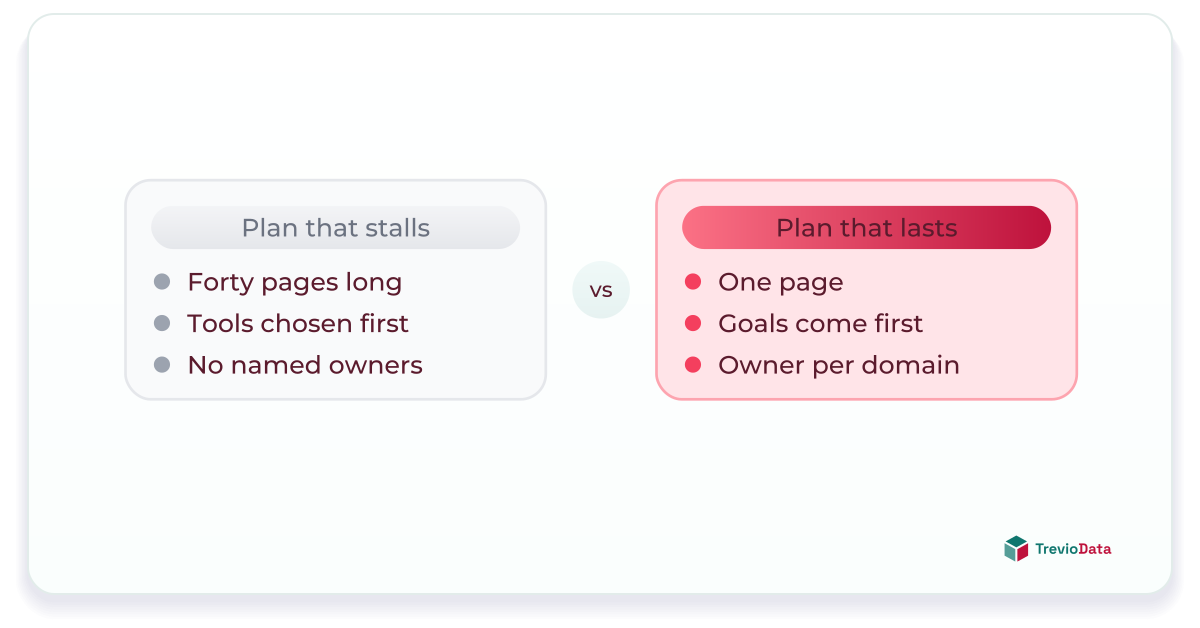
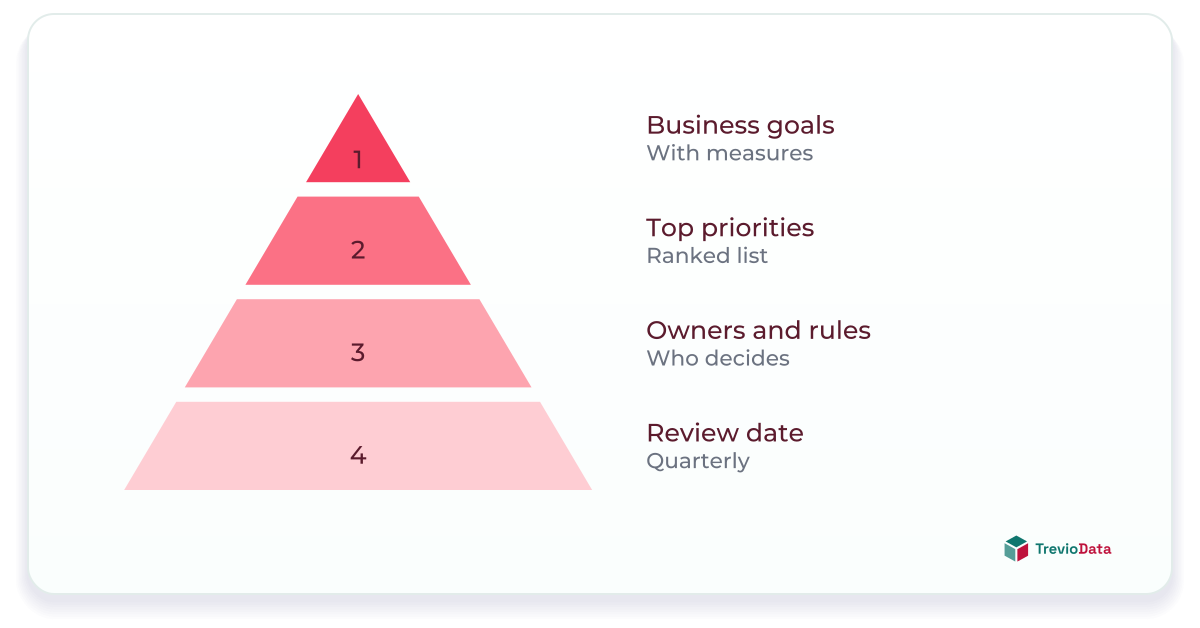
The summary page is the part people actually read, so write it first and keep it tight. A version that has worked well for mid-sized companies has five short blocks. The first states the three business goals and their measures. The second lists the four or five data domains that matter most, each with an owner. The third lists the top three priorities from your ranked table, with a start date and an end date. The fourth names the rules you are adopting this year, such as agreed definitions and a quarterly access review. The fifth shows the review calendar.
I once helped a retail group that began with a forty-page document. Nobody finished it, and the first project slipped by two quarters. We cut it to a single page and a shared sheet of priorities. The first fix, a repair of the product data feed, was live within ten weeks, and the one-page plan became the thing leaders pointed to in meetings. Shorter was not a compromise, it was the reason the plan got used.
Keep the detailed material in appendices: the inventory, the scoring sheet and the definitions list. Link to them from the summary so people can dig in when they need to. Update the summary every quarter, and put the date at the top so readers know it is current.
Choosing Tools Last
Tools come after goals, owners and priorities. When the time comes, write down the problem each tool must solve, the person who will run it and the cost at your expected volume. My ranking of data management software compares platforms, pipeline tools and governance products so you can shortlist quickly.
If you already own tools that do the job, keep them. I have seen several strategies where the best first step was simply switching on features the company already paid for.
How to Know Your Strategy Is Ready
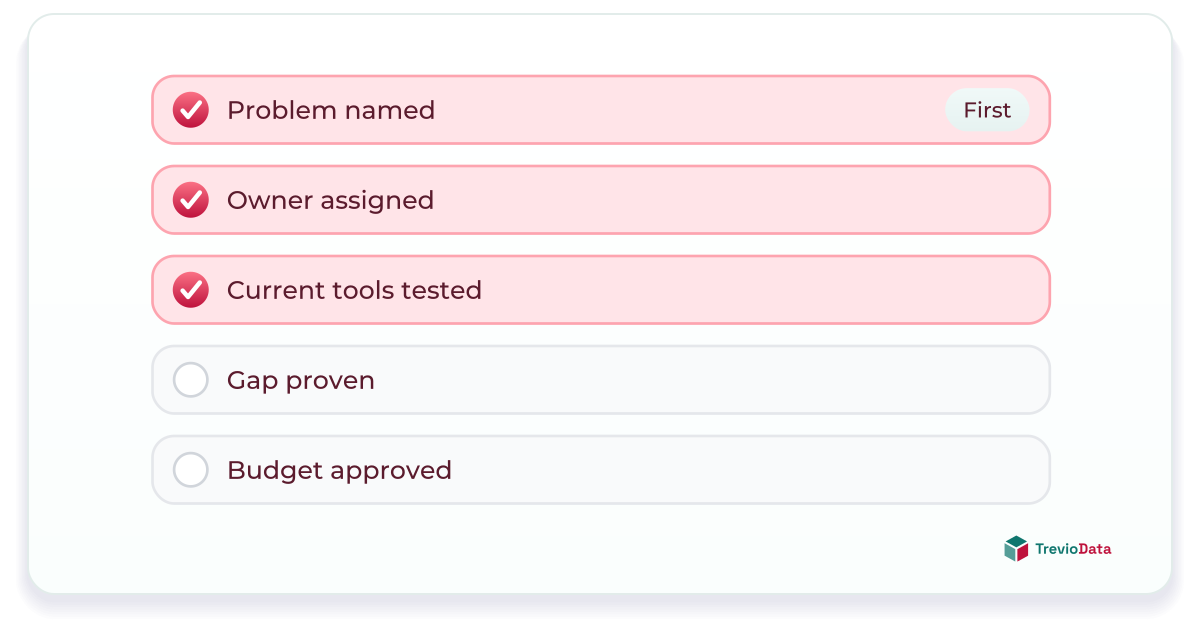
Before you present the plan, check it against this list:
- Each goal has a measure and a date.
- Every priority has one named owner.
- The first project fits into three months.
- The plan names what you will not do this year.
- A quarterly review is already in the calendar.
If three or more of those are missing, the plan is a draft. Finish it before you ask for budget.
Questions About Data Management Strategy
What Is a Data Management Strategy?
A data management strategy is a short, written plan that says which business goals your data has to support, which data matters most, who owns it, how it is stored and protected and what you will fix first. The best ones fit on a few pages and name owners, deadlines and measures. A long document that nobody reads is not a strategy.
How Long Should a Data Management Strategy Be?
I aim for five to ten pages plus a one-page summary. Anything longer tends to describe the ideal state instead of the next twelve months. If a section does not lead to a decision, a task or an owner, I cut it.
Who Should Own the Data Management Strategy?
A business leader should own it, with a data lead running it day to day. When IT alone owns it, the strategy turns into a tool plan and loses business support. When only the business owns it, nobody checks whether it is technically realistic.
How Is a Data Management Strategy Different from a Data Strategy?
A data strategy says how data creates value, for example through analytics, products or AI. A data management strategy covers the practical work underneath: sources, pipelines, quality, storage, ownership and access. You need the second to deliver the first, and most companies underinvest in it.
How Often Should I Update the Strategy?
Review it every quarter and rewrite priorities once a year. Quarterly reviews keep it tied to real projects, and the annual rewrite catches changes in the business, such as a merger, a new market or a new platform.
Do I Need to Buy New Software to Follow a Data Management Strategy?
Rarely at the start. Most first-year priorities, such as naming owners, agreeing on definitions and repairing failing pipelines, need little or no new software. Buy a tool when you can name the specific problem it solves and the person who will run it.
How Do I Get Leadership to Support It?
Show them the cost of the current mess in their own terms: hours of report building, disputes about numbers and delayed projects. Pair that with one small first project and a date by which it will show a result. Leaders back plans that start small and prove themselves quickly.
Sources
- Harvard Business Review: Only 3% of Companies’ Data Meets Basic Quality Standards
- Gartner: How to Improve Your Data Quality
Note: This article is general information, not legal, financial or tax advice. Figures and examples are estimates based on typical projects, so check current details with your providers and advisers before you decide.
Was this article helpful?
Thank you for letting us know.
Camille leads the Trevio editorial team and works with our consultants to turn real client projects into practical guides on data strategy, engineering and governance. Before joining Trevio, she spent 11 years in data engineering and analytics roles. She has since edited more than 300 articles on data management and reviewed pipelines and platforms from over 100 client projects. She is based in Denver, Colorado.