Key Takeaways
- A data management framework splits the work into six parts: strategy, governance, architecture, quality, security and lifecycle.
- The parts depend on each other, and your weakest one caps the value of the rest.
- Score each part from 1 to 5 with evidence, then use the weighted formula to find the gap that matters most.
- Start with a light model you can explain in five minutes and refine it as the program matures.
Ask five people what data management means and you will hear five answers: databases, reports, security, cleaning, compliance. A framework puts all of them on one page and shows how they relate. It is the tool I reach for in the first week of a data management consulting project, because it turns a vague complaint such as our data is a mess into something you can score and fix.
The best-known reference model is the DAMA-DMBOK, published by DAMA International, which lists eleven knowledge areas. It is thorough, and also more than most mid-sized companies can staff. The six-part version below is what I use in practice.
The Six-Part Model in One Table
| Component | The question it answers | Typical evidence of maturity |
|---|---|---|
| 1. Strategy and value | What does data have to achieve for the business? | Written goals with measures and an owner |
| 2. Governance and ownership | Who decides what the data means and who can use it? | Named owners, agreed definitions, access rules |
| 3. Architecture and integration | Where does data live and how does it move? | A source map, monitored pipelines, a central store |
| 4. Quality and metadata | Can people trust and find the data? | Quality checks, a catalog or glossary, a scorecard |
| 5. Security and privacy | Who is protected and how is access controlled? | Role-based access, masking, audit logs |
| 6. Lifecycle and operations | How is data created, kept and retired? | Retention rules, backups, runbooks, support process |
Component One: Strategy and Value
Everything starts with what the business needs. A retailer that wants fewer stock-outs needs reliable inventory and sales data. A healthcare group that wants shorter billing cycles needs consistent patient and claims records. Write the goals down and attach a measure to each, then work backward to the data they depend on. My guide to data management strategy walks through that step in detail.
Without this component, data teams build what is interesting instead of what is needed. In my experience that is the most common reason a technically good platform is barely used.
Component Two: Governance and Ownership
Governance sounds heavy, but at its core it answers three questions: who owns each domain, what do key terms mean and who may see what. A company with one page that answers these is ahead of most.
Governance also decides how disputes get settled. When finance and sales disagree about a revenue figure, someone with authority picks the definition and records it. Teams that skip this step end up fighting the same battle each quarter.
Component Three: Architecture and Integration
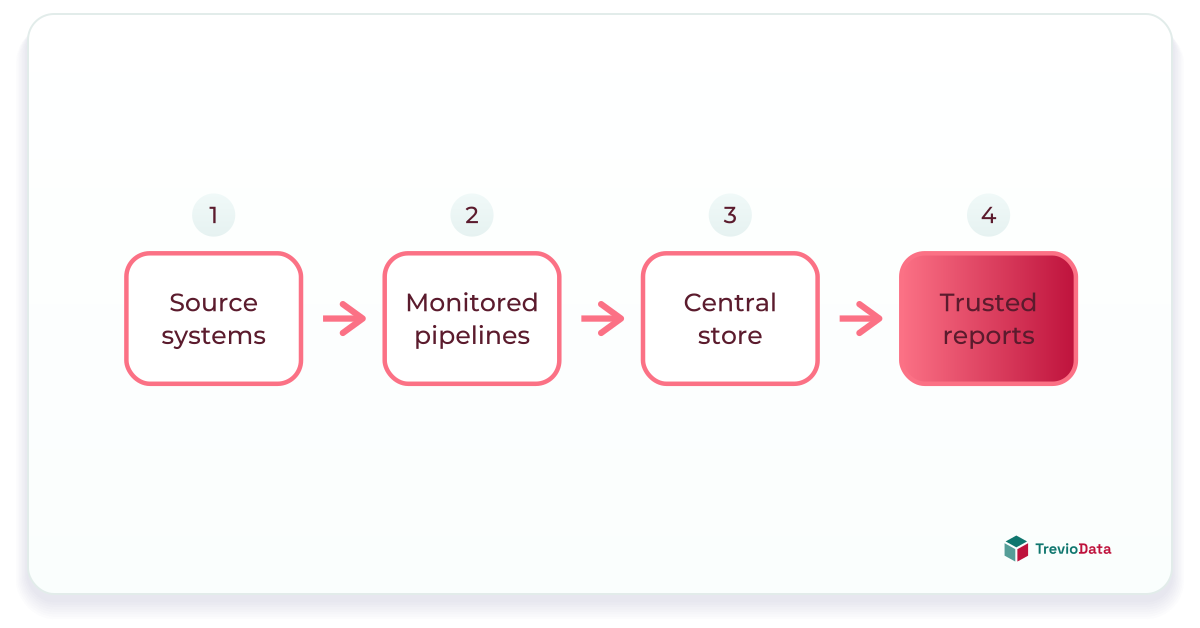
This is the plumbing: source systems, pipelines, the warehouse or lake and the tools people use to read data. Good architecture is boring. Data flows on a schedule, failures raise alerts and every important table has a known origin.
The usual trouble spots are point-to-point integrations that nobody documented and spreadsheets that feed reports. A source map, even a rough one, exposes both quickly. When you reach the point of choosing platforms, my comparison of data management software helps you shortlist.
Component Four: Quality and Metadata
Quality means the data is complete, accurate, consistent and timely for its purpose. Metadata is the description that lets people find it and know what it means. They belong together, because a table of excellent data that nobody can find or interpret is still useless.
Gartner reports that poor data quality costs organizations an average of $12.9 million per year (Gartner). Whatever your own figure, put checks at the entry points and track a short scorecard, as described in my list of data management best practices.
Component Five: Security and Privacy
Security decides who can see, change and export data, and privacy rules decide what you may do with personal information. Role-based access, masking of sensitive fields and audit logs are the core controls. Requirements vary by industry and region, so confirm the current rules that apply to you with your legal and security advisors.
Component Six: Lifecycle and Operations
Data has a life: it is created, used, archived and eventually deleted. Operations covers the daily running of the platform, including backups, support requests and incident handling. Teams often neglect this part until the first outage or audit request. Set retention periods, write short runbooks for the top failures and decide who answers when a report breaks.
The Maturity Formula
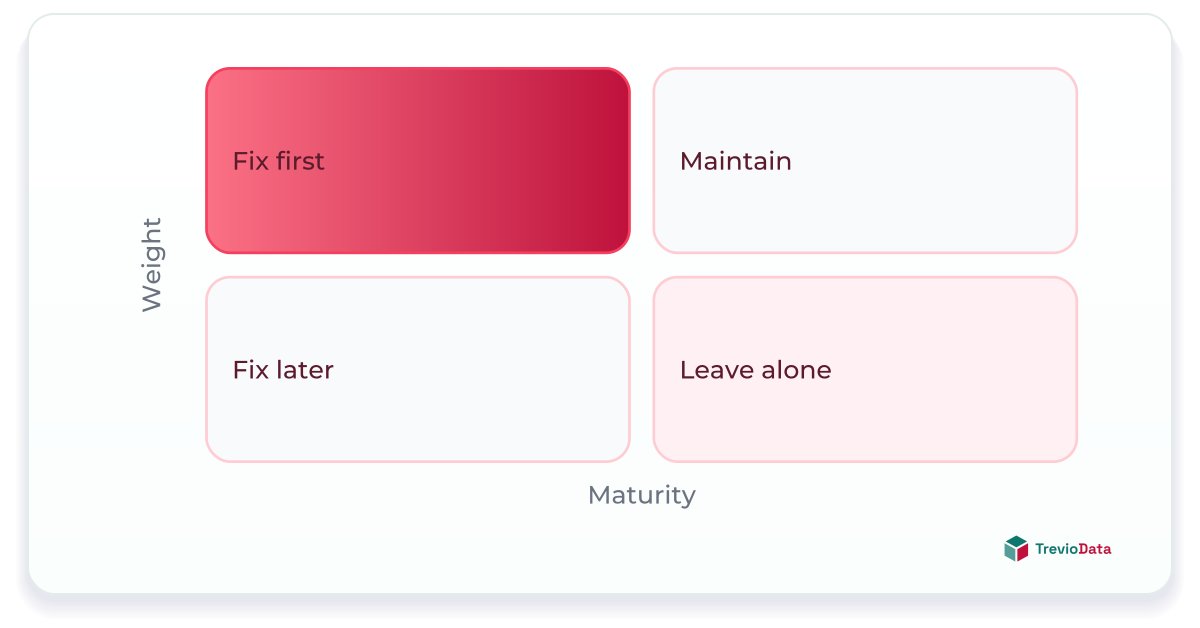
To find where to focus, score each component from 1 to 5, using evidence you can show. Then weight each component by how much it blocks your current goals, from 1 (barely) to 3 (blocks the goal) and calculate:
Gap score = (5 − maturity score) × weight
The component with the highest gap score is your first priority. The numbers below show how it works for a company that wants reliable weekly reporting.
| Component | Maturity (1 to 5) | Weight (1 to 3) | Gap score |
|---|---|---|---|
| Strategy and value | 3 | 1 | 2 |
| Governance and ownership | 1 | 3 | 12 |
| Architecture and integration | 2 | 3 | 9 |
| Quality and metadata | 2 | 2 | 6 |
| Security and privacy | 3 | 1 | 2 |
| Lifecycle and operations | 2 | 1 | 3 |
The scores are an illustration of the method. In this example governance comes out on top, and the cheapest fix is naming owners and agreeing on definitions, before anything is bought or built.
What the Five Levels Look Like
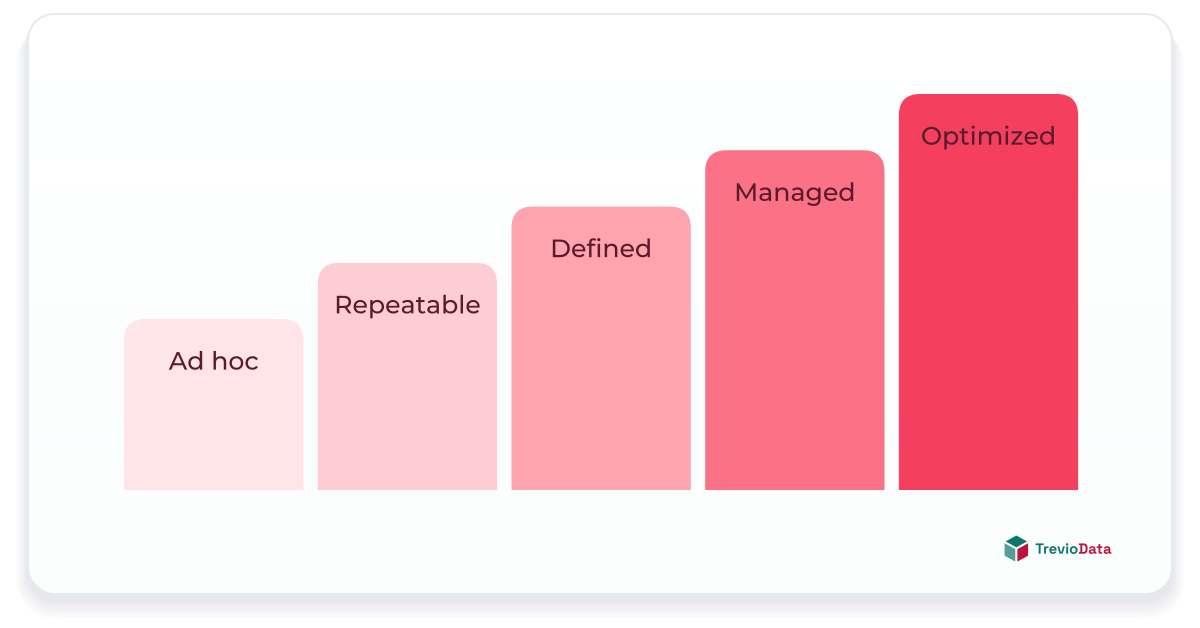
Use a plain scale so scorers agree. At level 1, the work happens by habit and depends on individuals. At level 2, some rules exist, but they apply only in places. At level 3, rules are written, owners are named and the work is repeatable. At level 4, the work is measured and results are reviewed regularly. At level 5, the work is improved continuously and teams trust the results without checking them.
Most mid-sized companies I see land between 1 and 3. That is normal, and level 3 across the board is a good target for a first year. Chasing level 5 everywhere is expensive and rarely needed. Once you know your scores, the data management roadmap shows how to sequence the improvements, and these data management examples show what teams did at each level.
Using the Framework in Your First Month
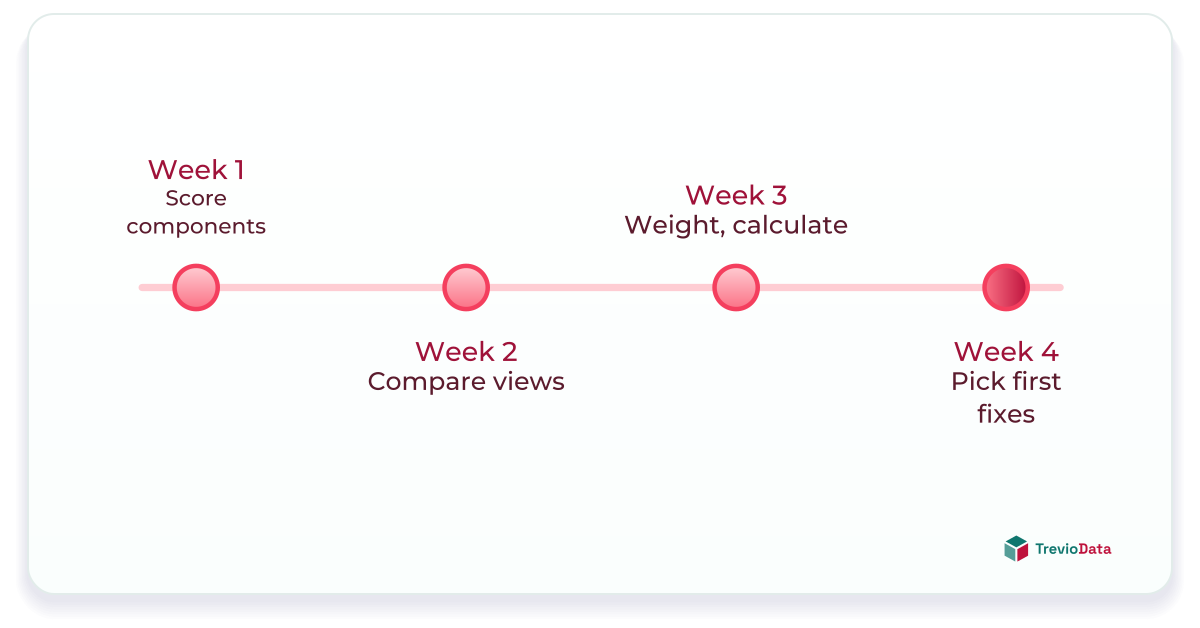
Week one is for agreeing on the model. Share the six components with your sponsor and the heads of the main domains, and adjust the names so they match how your company talks. Week two is for scoring. Ask two or three people from different teams to score each component separately, with a sentence of evidence for each score, then compare the results in a short meeting.
Disagreements are useful here. When finance gives governance a 3 and IT gives it a 1, the gap shows that people have different pictures of what exists. Resolve it by asking to see the owner list or the written definitions. If nobody can find them, the score is 1.
Week three is for weighting and calculating the gap scores. Week four is for choosing the top one or two gaps and writing a plan for each, with an owner and a date. Keep the plan small. A framework that leads to two finished improvements is worth more than one that leads to a long list of intentions.
Keep the evidence in one shared folder, so the next round starts from facts instead of memory. A link to the owner list, the definitions page and the latest scorecard is usually enough.
Repeat the scoring every six months. Seeing a component move from 2 to 3 is motivating for the team, and it gives your sponsor a simple way to follow progress without reading technical reports.
Common Ways Teams Misuse a Framework
The first mistake is treating the framework as the project. A poster of six components does nothing until someone fixes a pipeline or names an owner. The second is scoring with opinion. Optimistic scores hide the gaps you most need to see, so insist on evidence. The third is trying to raise every component at once. Spreading effort across six areas usually means progress in none, and the gap score exists to prevent exactly that.
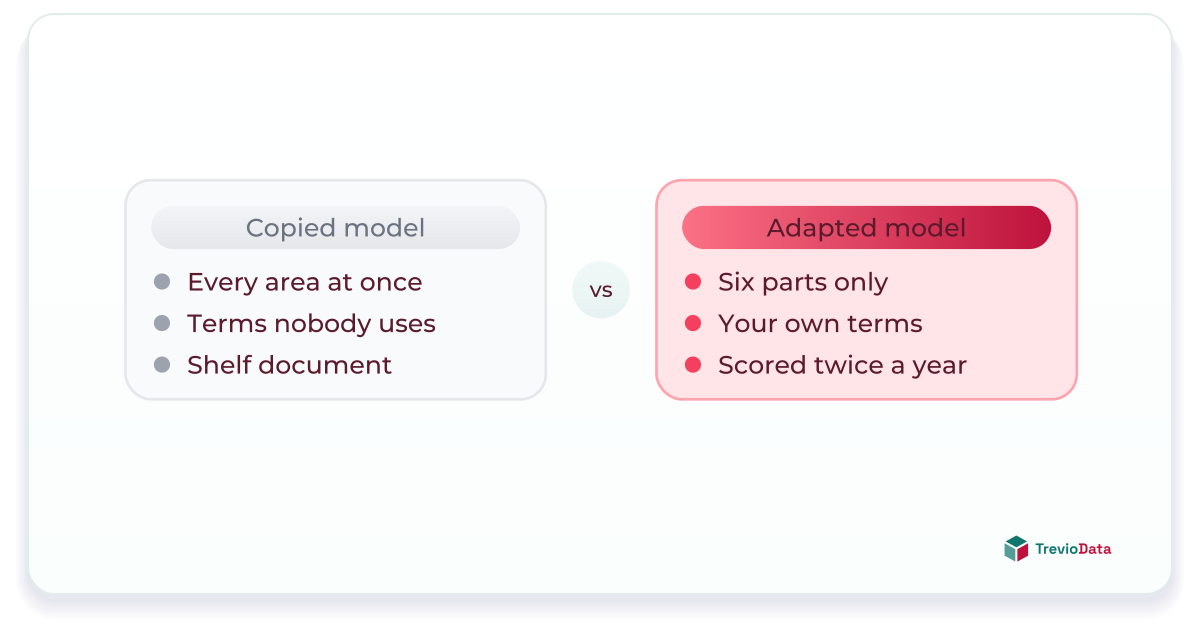
The fourth mistake is copying a large model without adapting it. The eleven DAMA-DMBOK areas are a useful reference, but a team of five cannot own eleven areas. Merge or drop the ones that do not matter yet, and note them for later. The fifth is forgetting the business. If a component cannot be linked to a goal, it does not need attention this year.
How to Pick and Adapt a Framework
Do not adopt a model because it is famous. Check it against your situation:
- Can you explain it to a new manager in five minutes?
- Does every component have someone who could own it?
- Does it show which part blocks your most important goal?
- Can you score it with evidence, not opinion?
If the DAMA-DMBOK areas fit your size and staffing, use them. If not, a six-part model like the one above works and you can add detail later. Adapt the names so they match how your company already talks.
Questions About Data Management Frameworks
What Is a Data Management Framework?
A data management framework is a structured model that breaks data management into parts, such as governance, architecture, quality, security and lifecycle, and shows how they connect. It gives you a shared vocabulary and a checklist, so you can see what your company covers and what it ignores.
Which Data Management Framework Should I Use?
The best-known reference is the DAMA-DMBOK from DAMA International, which describes eleven knowledge areas. For most mid-sized companies I use a smaller six-part model, because eleven areas are hard to staff. Start with a model you can explain in five minutes, and grow it as your program matures.
What Is the Difference Between a Framework and a Strategy?
A strategy says what you will do this year and why. A framework is the structure that organizes the work, the same way a floor plan organizes a house. You need the framework to see the whole picture, and the strategy to decide which rooms to build first.
How Long Does It Take to Put a Framework in Place?
Expect two to four weeks to score your current state and agree on the model, and several months to raise the weak areas. Do not try to bring every component to a high level at once. Fix the lowest-scoring areas that block your goals first.
Do Small Companies Need a Framework?
A light version helps even a ten-person team. A one-page version with six headings, one owner for each and a score out of five takes an afternoon and shows you where the gaps are.
How Do I Score My Maturity Honestly?
Use evidence, not opinion. For each level, write what you would see if it were true, such as a named owner, a written rule or a monitored pipeline, and give credit only if you can show it. Have two people from different teams score separately, then compare the results.
Can a Framework Include AI and Analytics?
Yes, and it should. AI and analytics are consumers of the data your framework manages. Add a use-case layer on top of the six components, and check for each use case whether the data it needs is owned, documented, high quality and secure.
Sources
Note: This article is general information, not legal, financial or tax advice. Figures and examples are estimates based on typical projects, so check current details with your providers and advisers before you decide.
Was this article helpful?
Thank you for letting us know.
Camille leads the Trevio editorial team and works with our consultants to turn real client projects into practical guides on data strategy, engineering and governance. Before joining Trevio, she spent 11 years in data engineering and analytics roles. She has since edited more than 300 articles on data management and reviewed pipelines and platforms from over 100 client projects. She is based in Denver, Colorado.