Key Takeaways
- A practical data architecture framework has six parts: sources, ingestion, storage, modeling, serving and governance.
- Governance runs across every layer, so it needs an owner from the start.
- A weighted fit score shows which layer to fix first, based on evidence and not on opinion.
- Keep the framework short, name an owner for every layer and review it every quarter.
Most companies do not choose a data architecture. They collect one, one tool at a time. A framework gives the collection a shape, so the next tool has a place to go and the last one has a reason to stay. If you want help applying it, data architecture consulting usually starts by mapping your systems onto the layers below.
I use a six-layer model because it is small enough to remember and complete enough to find real gaps. This article explains each layer, shows how they connect, and gives you a formula to score your own setup.
The Six Layers at a Glance
| Layer | Question it answers | Typical components | Common failure |
|---|---|---|---|
| 1. Sources | Where does data start? | CRM, billing, web, devices, files | Nobody knows the full list |
| 2. Ingestion | How does it move? | Batch loads, change capture, streams | Point-to-point scripts |
| 3. Storage | Where does it live? | Warehouse, lake, lakehouse | Copies in many places |
| 4. Modeling | What does it mean? | Core tables, metrics, definitions | Every team defines revenue differently |
| 5. Serving | Who uses it and how? | Dashboards, APIs, data products, ML | Reports built on raw tables |
| 6. Governance | Who is accountable? | Owners, access, quality, catalog | Rules that nobody enforces |
What a Data Architecture Framework Is, and What It Is Not
A framework is a shared way of thinking about your data landscape. It names the layers, says what belongs in each one and sets the rules for how data passes from one to the next. It is not a product, a vendor choice or a single diagram that you draw once and file away.
It also differs from a strategy. A strategy says what you want to achieve and why, and my guide to data architecture strategy covers that part. The framework is the structure that carries the strategy out. If the strategy says you want one trusted view of the customer, the framework says which layer holds the customer record, who owns it and how it reaches a report.
A good framework passes a simple test: a new engineer can read it in an hour and place any system, table or report in the right layer. If they cannot, it is too abstract or too long.
Layer One: Sources
Start by listing every place data is created. That includes the obvious systems such as your CRM, ERP, billing tool and website, and the less obvious ones: spreadsheets that finance maintains by hand, vendor exports, and forms on a shared drive. I have never reviewed a company whose first list was complete, and the gaps are usually where the trouble is.
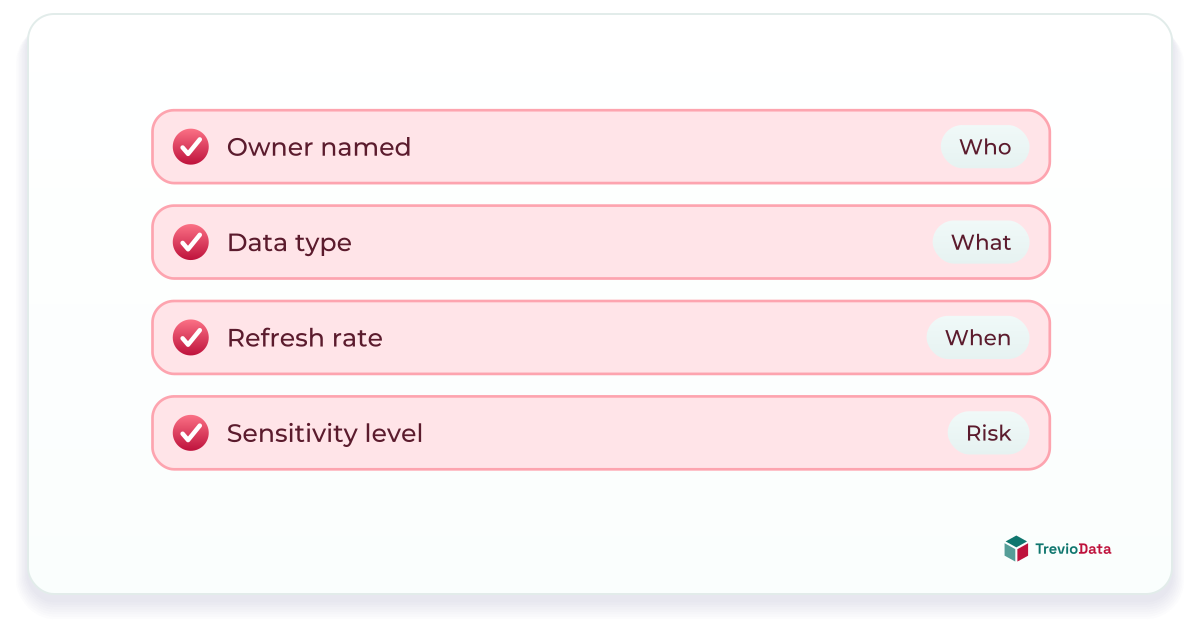
For each source, record an owner, the type of data, how often it changes and how sensitive it is. A shared sheet with six columns is enough. This inventory becomes the input for every later decision, from platform sizing to access control.
Layer Two: Ingestion
Ingestion is how data leaves a source and reaches your storage. The main choices are batch loads on a schedule, change data capture that copies only what changed, and streaming for cases that need seconds, not hours. Most reporting needs nothing faster than hourly or daily batches, and I advise you to resist streaming until a business need requires it.
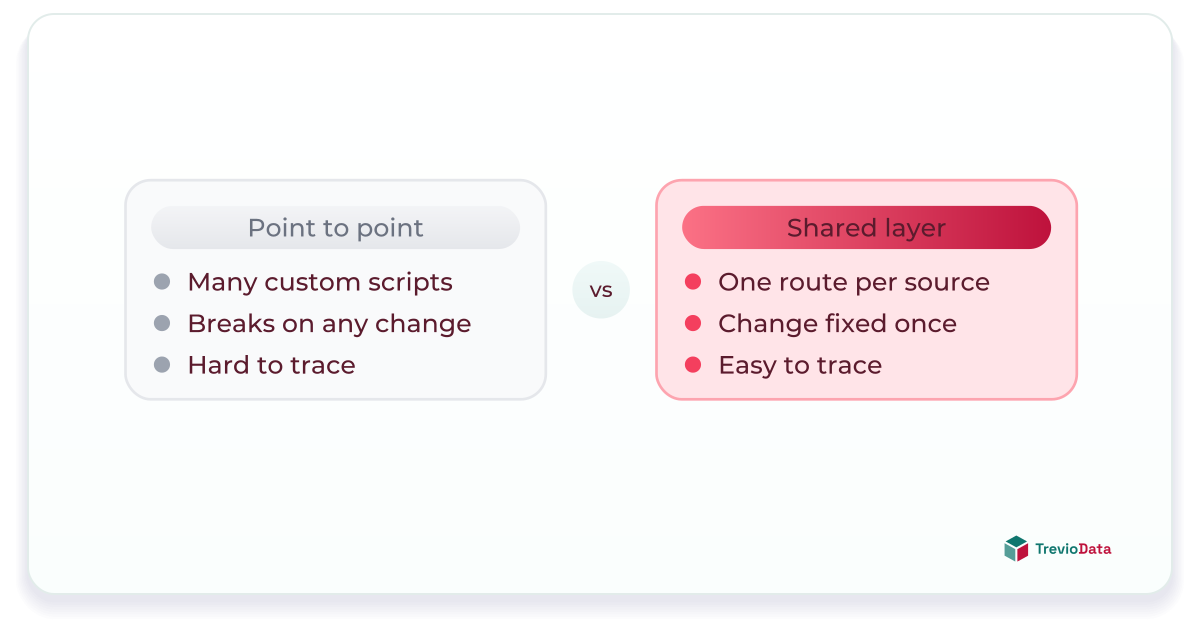
The rule that matters most here is to avoid point-to-point connections. When every system talks directly to every other system, ten systems create up to forty-five links, and nobody can change one without breaking another. A shared ingestion layer turns that tangle into one path in and one path out. The details of building it belong to data engineering, and a short list of data architecture tools can help you choose.
Layer Three: Storage
Storage is where the data rests. The three common patterns are a warehouse for structured data, a lake for large volumes of raw and mixed files, and a lakehouse that combines both on open table formats. Each has trade-offs, and none is right for everyone.
| Pattern | Best for | Be careful with |
|---|---|---|
| Warehouse | Structured reporting, finance, SQL-first teams | Compute costs with always-on workloads |
| Lake | Large raw files, logs, images, data science | A swamp without cataloging and ownership |
| Lakehouse | Reporting and machine learning on one copy | More skills needed to run it well |
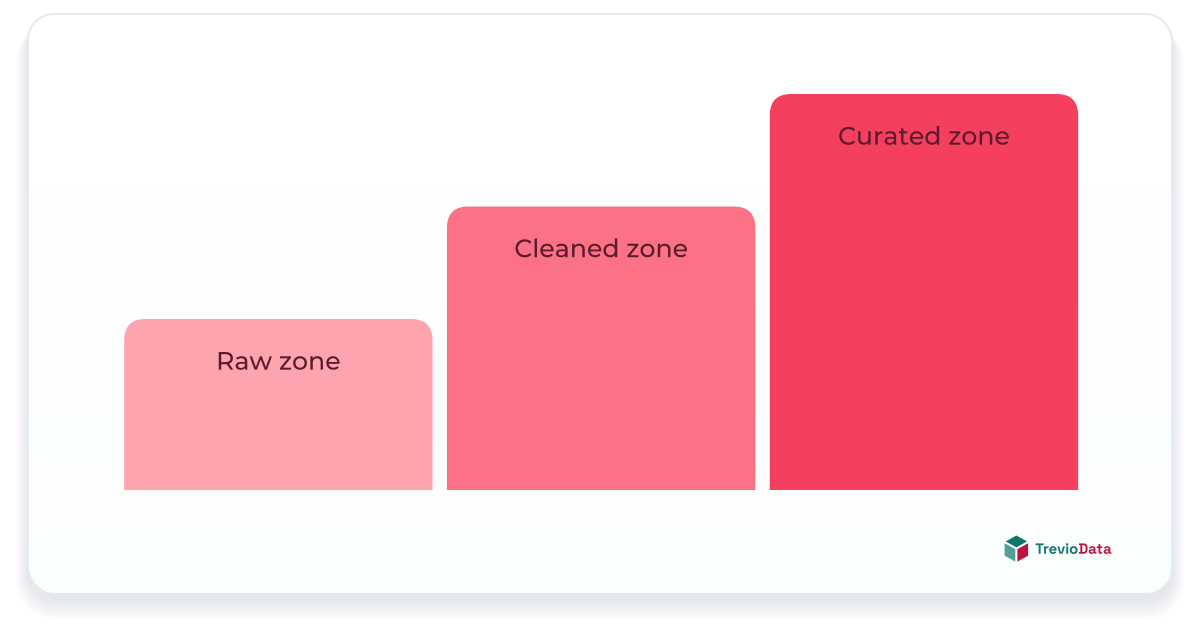
Within storage, I recommend three zones whatever the technology: a raw zone that mirrors sources, a cleaned zone with standard types and names, and a curated zone with business-ready tables. Keeping them separate lets you reprocess old data without touching what people use today.
Layer Four: Modeling
Modeling gives the data meaning. This is where you decide what a customer is, how revenue is calculated and which table is the single source for each. Teams often rush past this layer because it is less visible than a new platform, yet it causes more daily friction than any other.
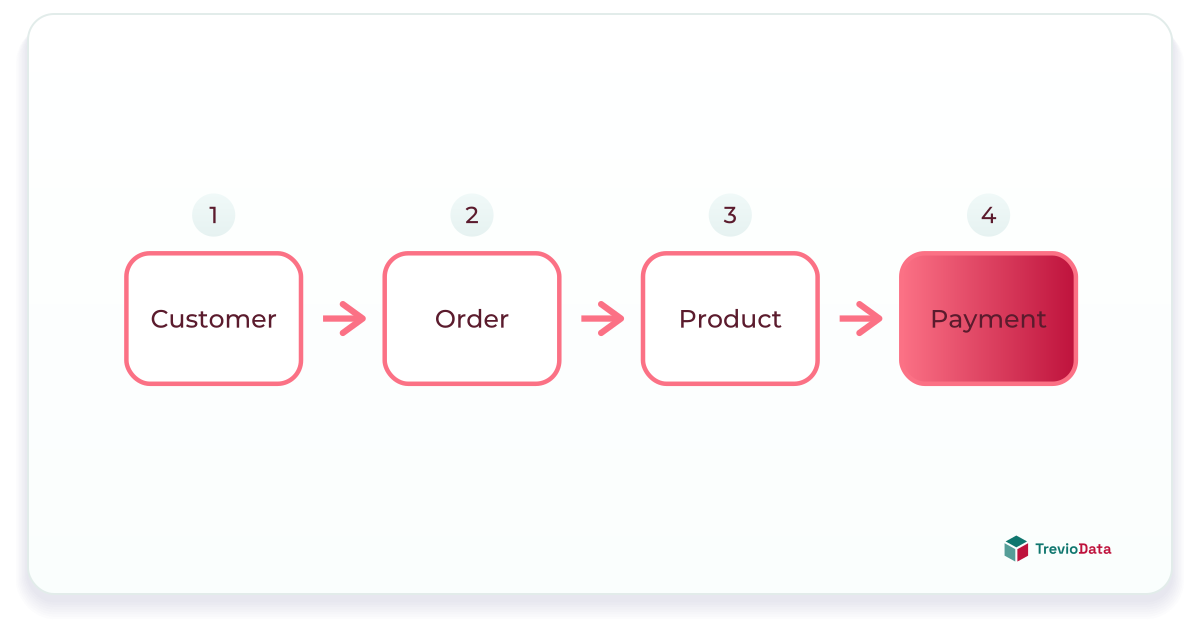
Create a small set of core entities, such as customer, product, order and account, with one definition each and one named owner. Write the ten most disputed metrics in one sentence apiece and publish them next to the reports that use them. Decide on naming rules early, for example singular table names, consistent date formats and a clear suffix for keys. These choices look small and save hours every week.
Layer Five: Serving
Serving is how people and systems consume data: dashboards, ad hoc queries, APIs, exports and machine learning features. The key rule is that consumers read from the curated zone and not from raw tables. When a report reads raw data, every change in a source can break it, and every analyst reinvents the same logic.
Think of the most important outputs as data products, each with an owner, a description, a refresh schedule and a quality promise. A product owner for the sales dashboard is a better contact than a shared inbox.
Layer Six: Governance
Governance runs across all layers. In an architecture, it covers four things: ownership, access, quality and documentation. Each domain has an owner who can say what the data means. Access follows roles and needs, and is reviewed on a schedule. Quality rules run automatically and alert a person. Documentation lives next to the thing it describes.
I treat governance as part of the design and not as an extra project. Many of the habits that make it work are listed in my data architecture best practices. Note that this article does not cover legal duties. Rules on personal data differ by country and sector, so check current requirements with your legal advisor.
The Architecture Fit Formula
To see which layer to strengthen first, score each layer from 1 to 5 using evidence. A score of 1 means nothing exists, 3 means it exists but is inconsistent, and 5 means it is documented, owned, monitored and reviewed. Then apply this formula:
Fit score = (S1 x W1) + (S2 x W2) + (S3 x W3) + (S4 x W4) + (S5 x W5) + (S6 x W6), divided by 5.
Here S is the layer score and W the weight, with the weights adding up to 100 percent. The weights below suit a company that mainly wants reliable reporting. Change them if your priorities differ, but write down why.
| Layer | Weight | Example score | Weighted | Gap to 5 |
|---|---|---|---|---|
| Sources | 10% | 3 | 0.30 | 0.20 |
| Ingestion | 15% | 2 | 0.30 | 0.45 |
| Storage | 15% | 4 | 0.60 | 0.15 |
| Modeling | 25% | 2 | 0.50 | 0.75 |
| Serving | 15% | 3 | 0.45 | 0.30 |
| Governance | 20% | 2 | 0.40 | 0.60 |
The example weighted scores add up to 2.55 out of 5, which is a fit score of 51 percent. The biggest gap is modeling, at 0.75, followed by governance at 0.60. So the first project would be agreed definitions and core entities, and not a new platform. That is the typical result I see: the layer with the most weight and the lowest score is rarely the one the company planned to buy a tool for.
How the Layers Connect: Three Common Patterns
The layers stay the same, but companies arrange them differently. Three patterns cover most cases.
The first is the central warehouse. Everything flows into one warehouse, is modeled there and is served from it. It is simple, cheap to run and fine until you have a lot of unstructured data or very different teams.
The second is the lakehouse. Raw and curated data share open storage, and the same copy serves reports and machine learning. It suits teams that already work with Python and large files.
The third is a domain-oriented design, often called a data mesh. Each business domain owns its own data products, and a small platform team provides shared tools. It can work in large organizations with strong domain teams. For most mid-sized companies it is heavy, because it demands more skilled owners than they have. I would start with a central design and move specific domains out only when a team can clearly run its own.
Whichever pattern you choose, write down why you chose it and what would make you revisit the choice. Future colleagues will thank you.
Where Frameworks Go Wrong
I see the same four mistakes repeatedly. The first is drawing the framework as a diagram of tools. Tools change, layers do not, so draw the layers first. The second is skipping ownership, which leaves the framework as a poster on a wall. The third is trying to cover the whole company at once. Start with one domain, for example sales or finance, and prove that the layers work there. The fourth is never reviewing it. A framework from three years ago describes a company that no longer exists.
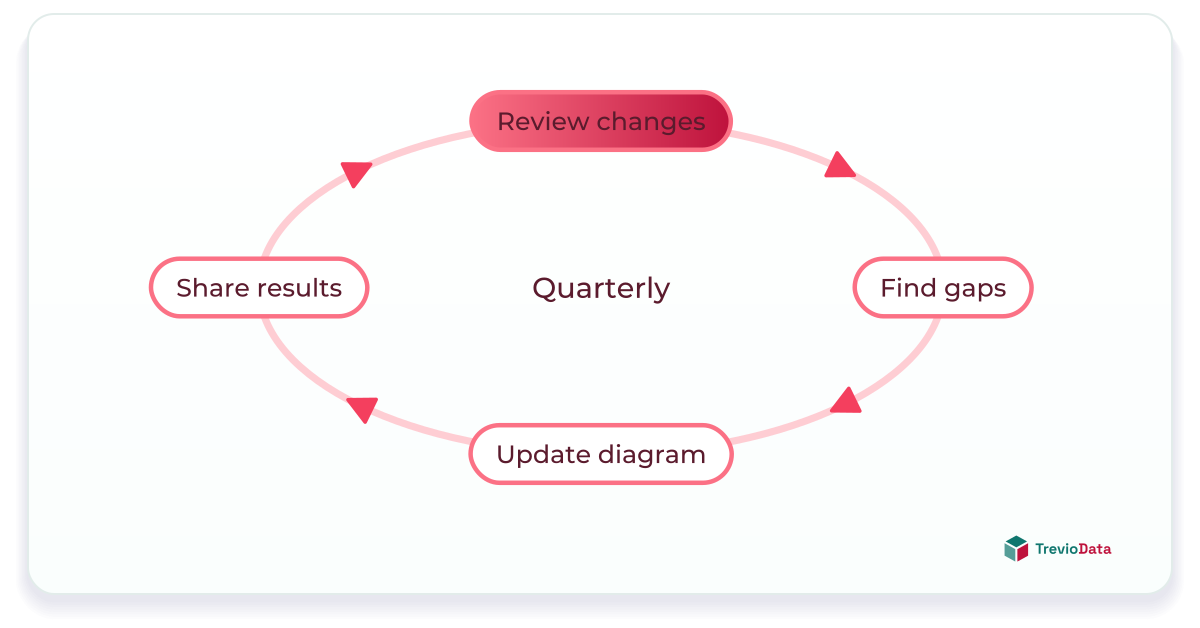
A short review each quarter fixes most of this. Ask what changed, which layer got weaker and which decision needs a new answer. The output is a short list of changes, which can feed directly into a dated data architecture roadmap.
How to Put the Framework to Work
Begin small and keep the first version short. Use this checklist for your first month:
- List all sources with an owner and a sensitivity level.
- Sketch the six layers and place each system in one layer.
- Score each layer with evidence and calculate the fit score.
- Pick the layer with the largest weighted gap as your first project.
- Write ten metric definitions and name an owner for each core entity.
- Put a quarterly review in the calendar.
If the scoring shows several large gaps at once, do not fix them all. One finished improvement with a visible result gives you the support to continue.
Questions About the Data Architecture Framework
What Is a Data Architecture Framework?
A data architecture framework is a set of layers, rules and decisions that describe how data is collected, stored, modeled, secured and served across your company. It gives every project the same structure to build on, so new work fits into what already exists.
Is a Data Architecture Framework the Same as TOGAF or DAMA?
No. TOGAF is a general enterprise architecture method, and DAMA-DMBOK is a body of knowledge for data management. Both are useful references. A framework in the sense of this article is your own short working model, which borrows from them and fits on a few pages.
How Many Layers Should the Framework Have?
Five or six is enough for most companies: sources, ingestion, storage, modeling, serving and a governance layer that runs across all of them. More layers make the diagram look thorough and the work harder to follow.
How Do I Use the Fit Score?
Score each layer from 1 to 5 with evidence, multiply by its weight and add the results. The score is a conversation starter. The most useful output is the single layer with the biggest weighted gap, because that is where your next project should go.
Do I Need a Data Lake, a Warehouse or a Lakehouse?
It depends on your data and skills. A warehouse suits structured reporting data, a lake suits large volumes of mixed files, and a lakehouse suits teams that combine reporting with machine learning. Pick the simplest option that meets your real questions.
How Long Does It Take to Put a Framework in Place?
A first version of the layers, naming rules and owners takes two to four weeks for one business area. Rolling it out across the company takes months, because most of the work is changing habits and migrating existing systems.
Who Should Own the Framework?
A named data or enterprise architect, with a business sponsor who can settle disputes. If you have no architect, give the role to your most senior data engineer and review the framework with the heads of finance, sales and operations once a quarter.
Note: This article is general information, not legal, financial or tax advice. Figures and examples are estimates based on typical projects, so check current details with your providers and advisers before you decide.
Was this article helpful?
Thank you for letting us know.
Camille leads the Trevio editorial team and works with our consultants to turn real client projects into practical guides on data strategy, engineering and governance. Before joining Trevio, she spent 11 years in data engineering and analytics roles. She has since edited more than 300 articles on data management and reviewed pipelines and platforms from over 100 client projects. She is based in Denver, Colorado.