Key Takeaways
- Small businesses can start with a few thousand records, a free visual tool and one clear question.
- Segmentation, basket analysis, churn lists and demand forecasts are the most realistic first wins.
- Most of the effort goes into cleaning data, not into modeling.
- Test every finding on a small group before you roll it out to everyone.
Most advice on data mining is written for companies with a data team. If you run a small business, you have customer lists, orders and invoices, and probably no analyst. That is enough to start. In this guide I explain what mining means at your size, which wins are realistic and how to run a first project in about 90 days. If you would rather have a guide at your side, my data mining consulting service starts with a short review of what you already hold.
I write from client work with small and mid-size firms, so the budgets and timelines below are typical ranges, not promises. Your own data will decide what is possible.
What Data Mining Means When You Have No Data Team
Data mining is the search for patterns in records you already keep, such as which customers buy together, who is about to leave or which days run hot. It uses statistics and simple machine learning, and a visual tool hides most of the math. You do not build anything from scratch. You load a table, pick a method and read the result.
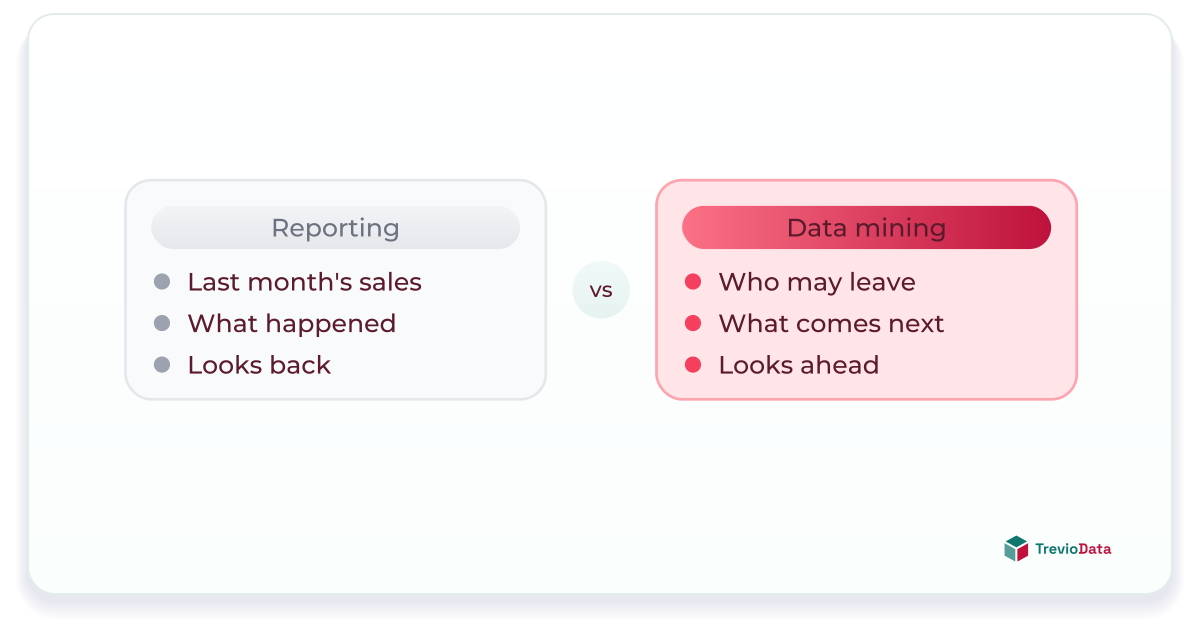
The difference from reporting is that a report tells you what happened, and mining tells you what goes with what or what is likely next. Both matter. A dashboard shows last month's sales, while a mining result might say that customers who buy product A in their first order come back twice as often.
Check Whether Your Data Is Good Enough
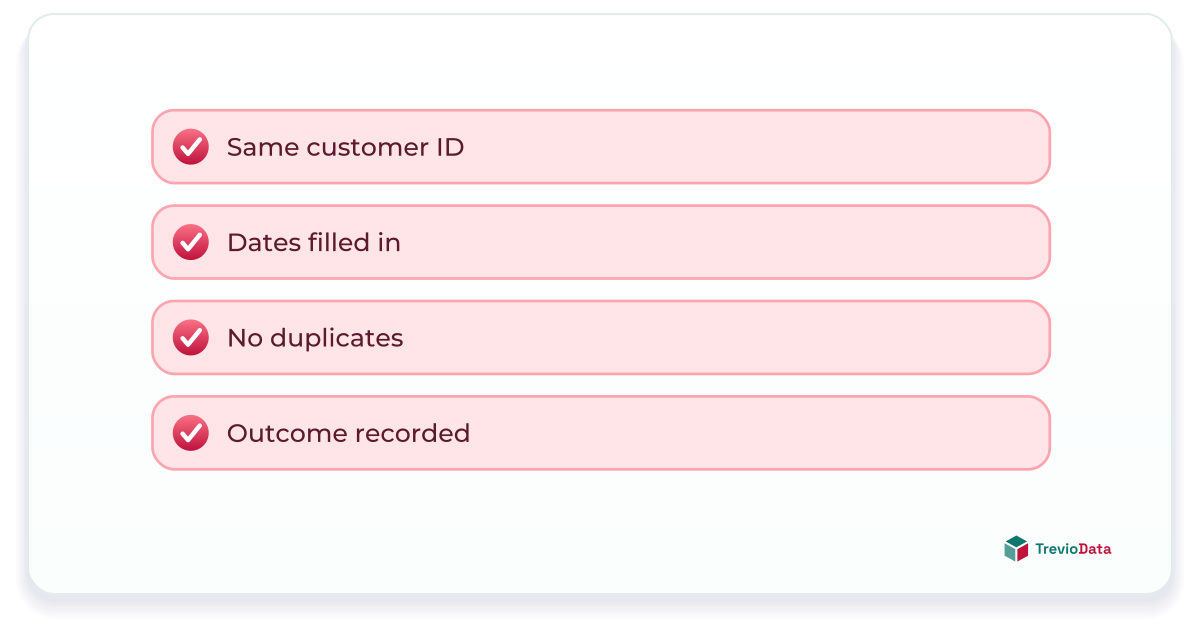
Most small firms have more usable data than they think. The trouble is where it sits: a shop system, a spreadsheet, an email tool and an accounting package. Before you pick a method, list your sources and check three things for each: how many rows, how far back they go and how complete the key fields are.
| Project | Data you need | Rough minimum |
|---|---|---|
| Customer segments | Customer ID, order dates, order values | A few thousand orders |
| Basket analysis | Order lines with product IDs | A few thousand orders |
| Churn list | Subscription dates, usage, support contacts | Several hundred customers, including some who left |
| Demand forecast | Sales by product and week, promotions | Two years of history |
| Lead scoring | Leads with source, activity and outcome | A few hundred closed leads |
If a source fails the check, you have found your first task. Add the missing field, give each customer one ID and record outcomes such as cancelled or won. A month of better records can be worth more than any tool.
Five Simple Wins That Fit a Small Business
These are the projects I suggest to owners who ask where to begin. Each one needs data you probably have and ends with an action, not a chart. For more detailed steps on each, see my ranked list of data mining use cases.
Group Customers by What They Actually Do
Segment your customers by how recently they bought, how often and how much. You will usually find a small group of loyal big spenders, a group of one-time buyers and a group that has drifted away. Each group needs a different message, and writing three emails is easier than writing one that fits nobody. Keep it to four to six segments that you can name in plain words.
Find the Products That Sell Together
Basket analysis shows which items appear in the same order more often than chance. Put those pairs on one shelf, one page or one bundle. In my client work, lifts of two to four percent in basket size are typical, which is small but almost free. Clean product codes first, or the pairs will be wrong.
Spot Customers Before They Leave
If you sell subscriptions, memberships or repeat services, a churn list tells you who to call this week. Look at the habits of past customers who left and see who now looks the same. Bain research cited in the Harvard Business Review says a 5 percent gain in retention can raise profits by 25 to 95 percent, though the range depends on your margins. A friendly call from the owner often saves more accounts than a discount.
Forecast What You Will Sell
With two years of weekly sales, a simple forecast helps you order the right amount. It helps a café plan staff and a shop plan stock. Mark promotions and holidays in your data, or the forecast will treat them as normal weeks. Compare it with last year's average, since a clever model must beat that to be worth using.
Rank Leads by How Likely They Are to Buy
If you sell to businesses, look at past leads and what separated the ones that bought. Source, company size and pages viewed often matter more than job title. A short ranked list lets you call the best leads first. Show the reasons behind each score, so you and your team trust it.
Free and Low-Cost Tools, and What a First Project Costs
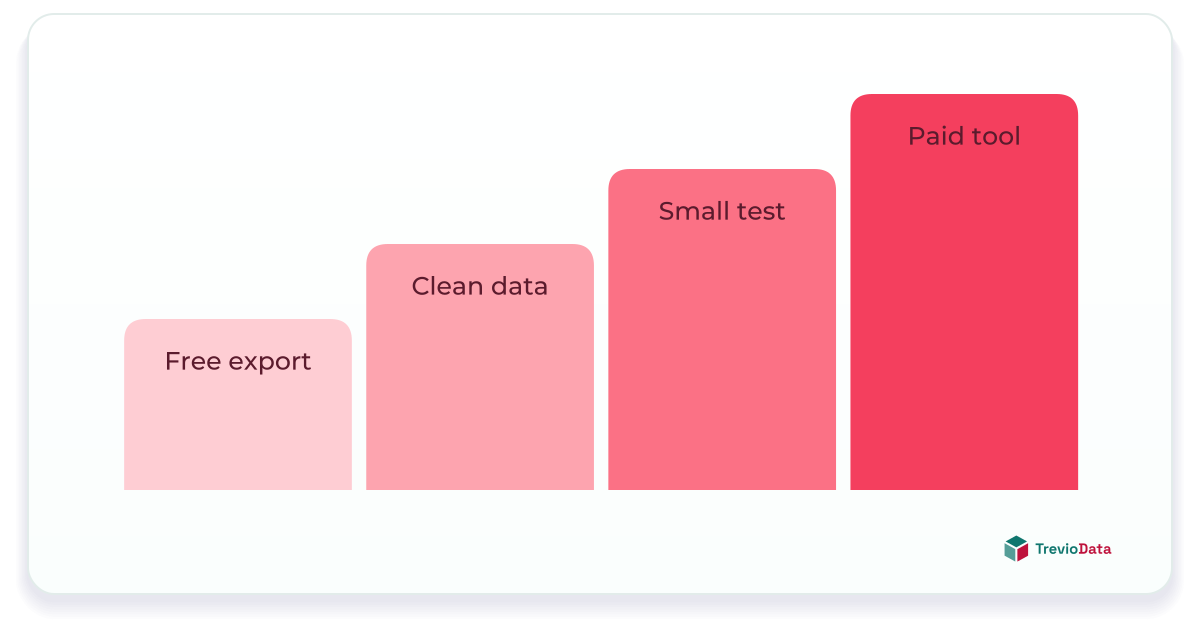
You can run all five wins in a free visual tool. KNIME and Orange are free to download, and Weka is open source under the GNU General Public License. Orange is the easiest to learn, and KNIME handles larger files and can connect to more sources. Paid platforms such as Alteryx list a Starter edition at $250 per user per month, billed annually. I compare the main options with prices in my ranking of data mining tools.
| Stage | What you do | Typical cost |
|---|---|---|
| Learn | Try one free tool on a small export | Free, plus a few hours |
| Prepare | Clean IDs, fill gaps, join sources | Mostly your time |
| Test | Run one model and a small campaign | Free tool, small campaign budget |
| Scale | Automate refreshes and reports | Paid tool or outside help |
The most expensive mistake I see is buying a platform before choosing a question. Prove one result in a free tool and the case for a paid one makes itself.
A 90-Day Plan for Your First Project
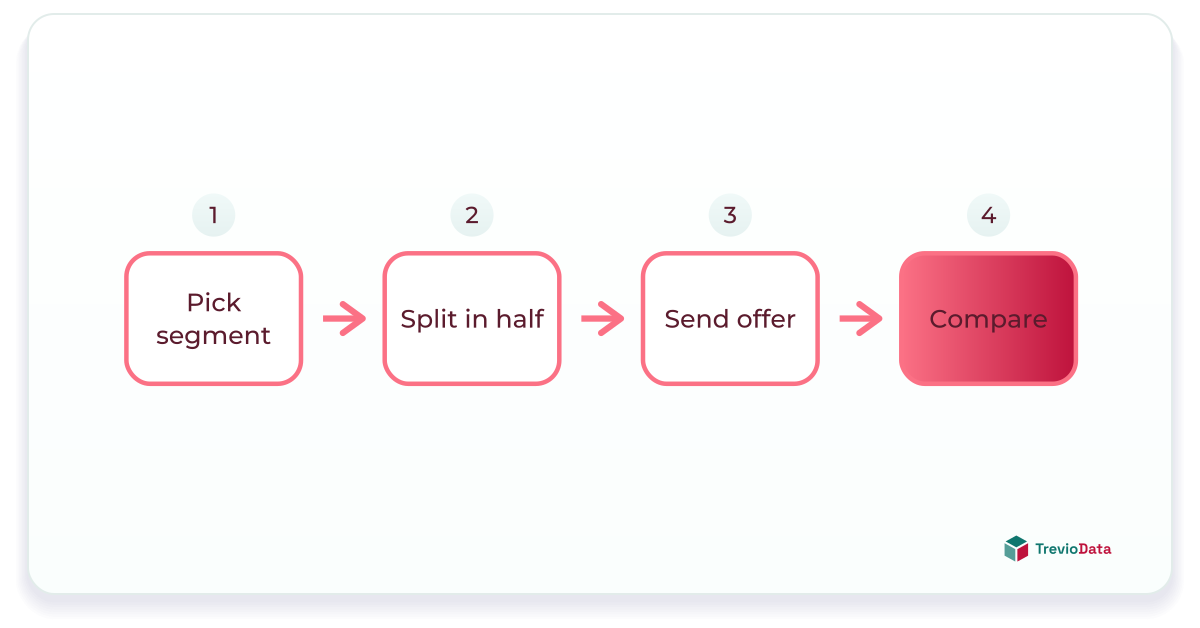
Work in three blocks of about 30 days. In the first block, pick one question, name an owner and gather the data. In the second, clean it, build the model and read the result with someone who knows your customers. In the third, run a small test against a control group and decide what to do. The diagram shows how the test and control groups work.
Keep the test simple. Send the tailored offer to half of a segment and the usual offer to the other half, then compare orders after two to four weeks. If the difference is small, you have learned that cheaply. If it is large, roll it out. My data mining examples show how other companies measured their results.
Mistakes Small Businesses Make, and What to Do Instead
- Starting with a tool instead of a question. Write the question in one sentence first.
- Mining before cleaning. Give every customer and product one ID before anything else.
- Trusting a model that nobody can explain. Show reasons next to each score.
- Collecting more data than you use. Keep only the fields that serve a question.
- Skipping the test. Run every change on a small group first.
Privacy also deserves a moment. Use only the personal data you need, keep it out of shared files and tell customers how you use it in your privacy policy. Rules differ by location, so confirm what applies to you with your legal advisor.
Market context can help you decide how much to invest. Research and Markets valued the data mining tools market at USD 1.23 billion in 2024, and I collect more figures like it in my page of data mining statistics. The point for you is not the size of the market but that the tools are now cheap enough for small firms.
How to Read a Result Without a Statistics Degree
You do not need to follow the math to judge a result. Ask four plain questions of anything a tool shows you. How many customers or orders is this based on? Was it tested on records the model had not seen? How much better is it than a simple rule, such as "customers who bought recently will buy again"? And can someone explain why the model says what it says?
If the answers are "a few dozen", "no", "barely" and "nobody knows", treat the result as an idea, not a finding. I have seen owners rebuild a whole pricing page on a pattern found in 40 orders. A small test costs a week and saves you from that.
How to Decide Whether to Do It Yourself or Get Help
Do the first project yourself if you have one owner with a few free hours a week, data in one or two places and a question that does not touch sensitive records. Bring in help if your data sits in many systems, the question involves personal or financial records or you want a result in weeks and not months. A short checklist helps:
- You can write the business question in one sentence.
- You know who will act on the result.
- Your key data is in one or two tidy places.
- You can run a small test within 90 days.
Questions About Data Mining for Small Business
Can a Small Business Really Use Data Mining?
Yes. You need a question, a few thousand records and a free tool. Customer lists, orders, invoices and website visits are enough for segmentation, basket analysis or a simple churn list. Small firms often move faster than large ones, since one person can own both the question and the action.
How Much Data Does a Small Business Need?
For a first test, a few thousand clean rows with a clear outcome column are often enough. Forecasting needs at least two years of history to see seasons. If you have less, start by recording the right fields now, so next year's analysis has something to work with.
What Does Data Mining for a Small Business Cost?
The software can be free. KNIME, Orange and Weka cost nothing to download. Your real cost is time, and perhaps a few days of outside help for the first project. Paid tools start in the hundreds of dollars per month, so test in a free tool first.
Do I Need to Hire a Data Scientist?
Not for a first project. An analyst or a curious owner can run a visual tool, and a consultant can review the result. Hire once you have several models running and need someone to maintain them.
Is It Safe to Mine Customer Data?
It can be, if you keep it simple. Use only the fields you need, keep personal details out of shared files and tell customers what you do with their data in your privacy policy. Privacy rules differ by location, so confirm the requirements that apply to you with your legal advisor.
What Is the Easiest First Project?
Basket analysis or a customer segment list. Both use data you already hold, need no coding in a visual tool and end with a clear action, such as a bundle or a tailored email. Churn lists come next for subscription firms.
How Do I Know If the Result Is Real?
Test it on records the model has not seen and compare it with a simple rule. If the model barely beats the rule, use the rule. Then run a small test, such as sending the tailored email to half the segment, and measure the difference.
Sources
- Harvard Business Review: The Value of Keeping the Right Customers
- Research and Markets: Data Mining Tools Market
- Alteryx: Pricing
Note: This article is general information, not legal, financial or tax advice. Figures and examples are estimates based on typical projects, so check current details with your providers and advisers before you decide.
Was this article helpful?
Thank you for letting us know.
Camille leads the Trevio editorial team and works with our consultants to turn real client projects into practical guides on data strategy, engineering and governance. Before joining Trevio, she spent 11 years in data engineering and analytics roles. She has since edited more than 300 articles on data management and reviewed pipelines and platforms from over 100 client projects. She is based in Denver, Colorado.